Growing up listening to Jacqueline du Pré’s landmark recording of Edward Elgar’s Cello Concerto has, for me at least, put other performers at a disadvantage.

I have heard it played live a few times over the years, but whoever the soloist was my subconscious would be making the comparison unbidden.

This all disappeared when 27-year-old British cello superstar Sheku Kanneh-Mason placed his hands on the fingerboard of his 1700 Matteo Goffriller instrument for the noble opening recitative that summons up the composer’s grief at the death and destruction of the Great War.

This was the start of a performance that can only be described as special – for its sweet lyrical tone, the depth of his musicality and his ability to sweep the audience away with the beauty of his playing.
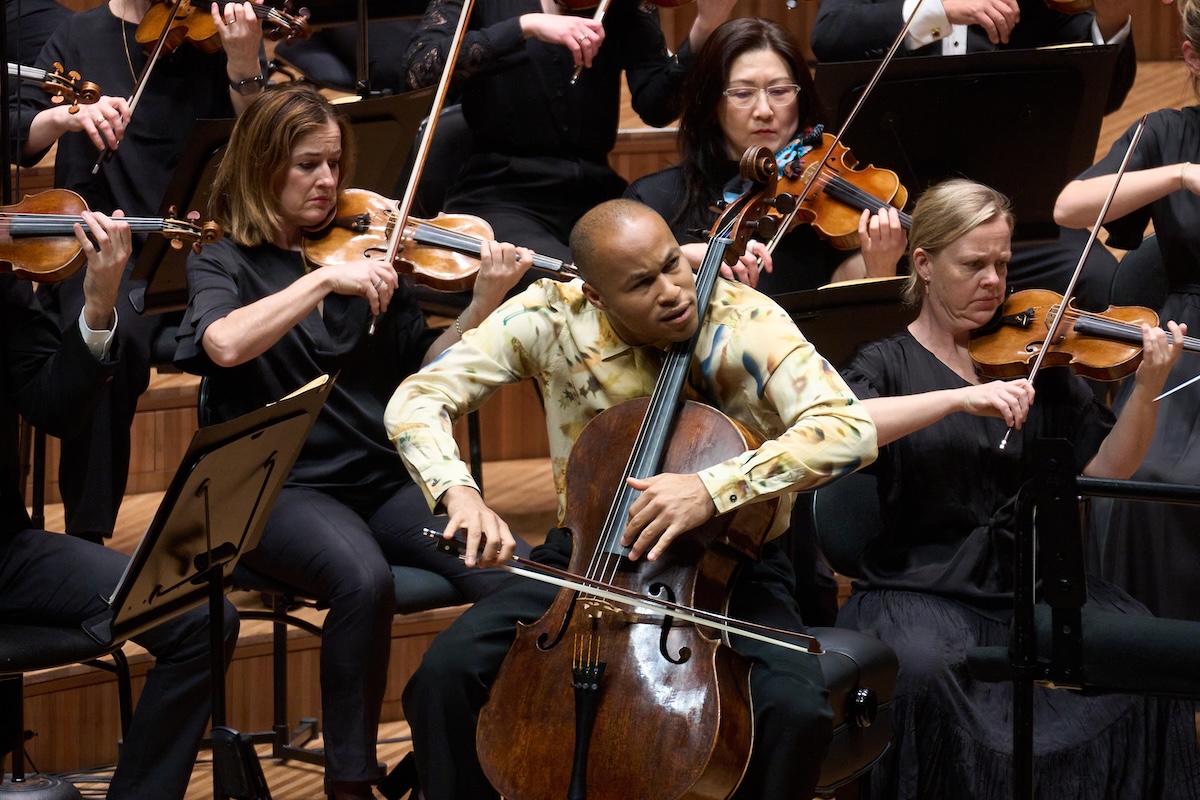
Sheku Kanneh-Mason and the Sydmey Symphony Orchestra. Photo © Jay Patel

After the heady momentum of the first movement Kanneh-Mason delivered the quicksilver fingering of the Allegro in the second movement with all the deftness of a Mendelssohn scherzo.

The broad and noble lines of the Adagio had just the right amount of vibrato, building to a lush and moving crescendo before dying away to an ethereal ending.

At times in the final movement it seemed like he was receiving the music from elsewhere as his eyes stared above the audience, sucking in his lips and looking over his shoulders at Young on one side or Concertmaster Andrew Haveron on the other.

The final three chords, after the whispered otherworldly return of the adagio’s theme, brought the house to its feet and after six curtain calls he returned for an encore, Lullaby by Scottish fiddler and composer Aiden O’Rourke, which he brought to a haunting and charming end by whistling its lovely tune over the double stopped cello.

Sheku Kanneh-Mason, Simone Young and the Sydmey Symphony Orchestra. Photo © Jay Patel

In the second half it was alphorns at 20 paces with Young conducting a majestic performance of Richard Strauss’s An Alpine Symphony.

Never a modest man, the composer once boasted that if need be he could describe a knife and fork in music. Fortunately this was never put to the test, but he certainly depicted an extraordinarily wide range of natural and man-made phenomena in his ‘‘symphony’’.

Inspiration for the work came from Strauss’ own experience when, as a boy, he was caught in a storm during a 24-hour mountain climb. Beginning and ending with Night this work – a tone poem in truth, and his farewell to the form after 30 years at it – is divided into 22 highly descriptive sections.

There is a sunrise to rival the famous opening of Thus Spake Zarathustra, and passages evoking alpine pastures – cue the massive alphorns placed either side of the stage in the choir stalls – thickets, tricky mountaineering moments, glaciers, “apparitions” and the most spectacular musical storm you’re likely to encounter.

The SSO led by Haveron was in scintillating form, with far too many marvellous solo moments to pick out, although special kudos must go to Guest Principal Horn Pablo Neva Collazo – on loan from Staatsorchester Stuttgart – who led the army of 20 horns, many of them offstage.

Interestingly this performance was a first – the use of the alphorns was only added in a recently published edition of the score. It will probably be a long time before we see them again as a work which employs 137 musicians only rarely gets staged.

_________________________________________________________________________________

Simone Young & Sheku Kanneh-Mason and the Sydney Symphony Orchestra peform again on 1 August.

Contribute to Limelight and support independent arts journalism.