




It would be unusual for two brothers in adulthood to spend as much time together as Lucas and Arthur Jussen.
Even more unusual is that the ‘act’ for which they are world-renowned is piano repertoire for four hands. The real clincher is that they appear to still – genuinely – enjoy the experience: even revel in it.
Lucas is now 33 and Arthur nearly 30. While they have been appearing in concert together since well before adolescence, there is still a very youthful energy, humility and charisma to them which is integral to their stage presence and technical performance.
According to their own narrative, they are co-equal artists: there is no ‘boss’. While they seem to have an instinctive sense about what the other is doing, it is also not like watching a single organism. They have different personalities and subtly contrasting styles: Lucas perhaps a little more introspective and gentle, while Arthur is more dramatic. But there is no questioning their tightness and absolute precision in executing diverse repertoire.
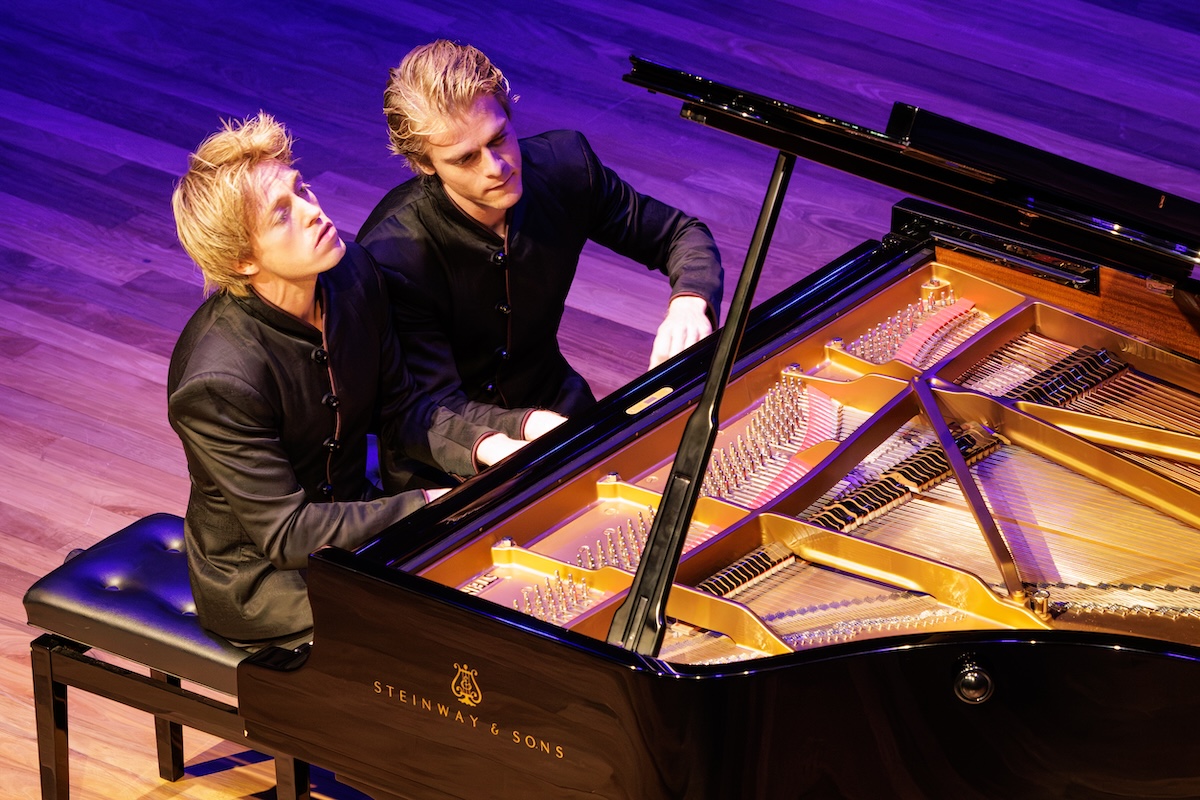
Lucas Jussen and Arthur Jussen at Snow Concert Hall, Canberra. Photo © Dalice Trost
The program itself really showcased how special this duo is. Beginning with Mozart’s Sonata for piano, 4 hands in D major, with Lucas on the top half of the keyboard and Arthur on the bottom, the three contrasting movements allowed the brothers to show off their approach in different modes, pushing and pulling tempos and establishing a choreography which gave the music flow and provided visual interest for the audience.
The atmosphere was light-hearted and the four-hands technique not especially challenging, but the drama and precision was all there.
Then, in Franz Schubert’s Fantasie in F minor for piano, the brothers really showed what they were capable of in terms of exposing the score’s darkness and light and pathos and drama. Compared to Mozart, Schubert is easier to play badly because of his demands for subtlety and mastery of technique. And the Jussens were absolutely superb in bringing this out. Drama and exquisite sensitivity were equally convincing and the effect utterly profound. Pauses were courageously long, but in the moment seemed perfectly judged.
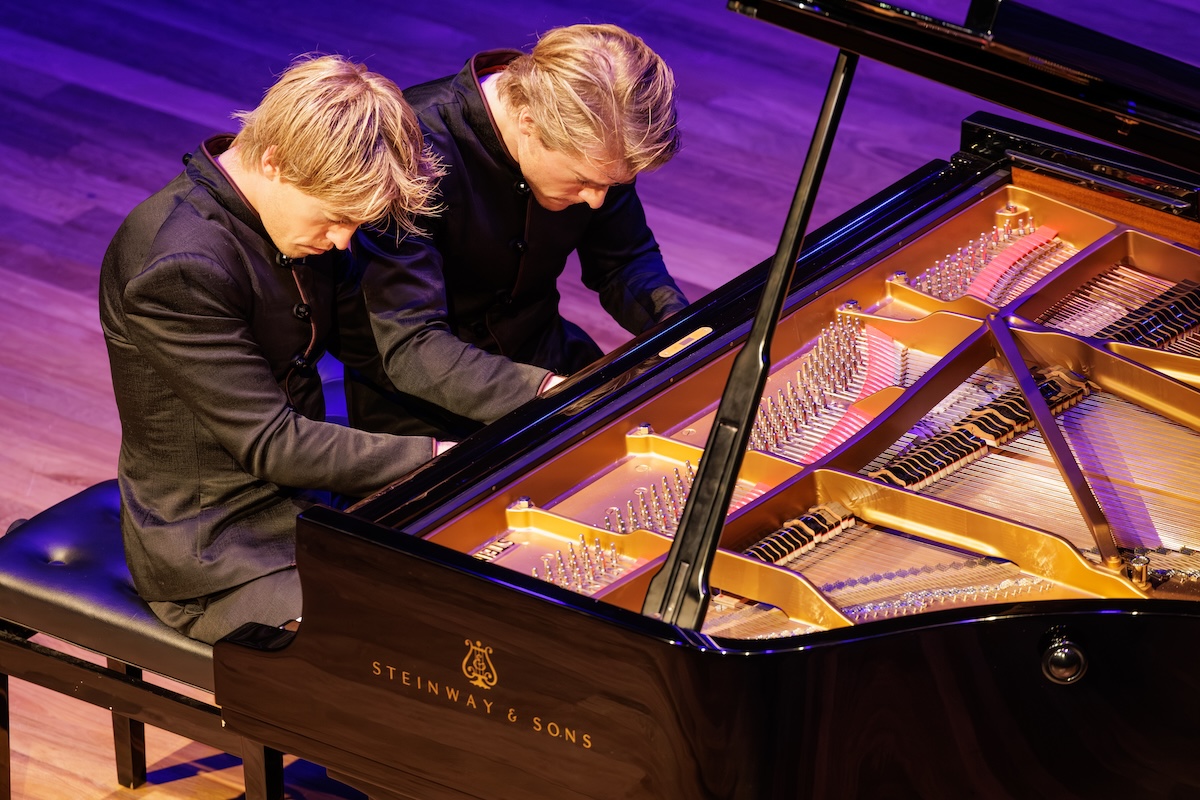
Lucas Jussen and Arthur Jussen at Snow Concert Hall, Canberra. Photo © Dalice Trost
In the last movement, following the return of the piece’s main theme, the players’ hands stayed on the keyboard for a full 10 seconds as the final note died away. Perfectly and intentionally rendered, this was the stuff of magic.
Just when one might have been questioning whether the brothers permanently occupied respective ends of the keyboard, they switched places for Felix Mendelssohn’s Andante and Allegro assai vivace in A major.
Because the theme is handed between players as it mounts and descends, it’s harder for the two artists to stay out of each other’s way, but so practised was this team that the four hands were perfectly sequenced, and the transitions utterly seamless – both players leaning back from the keyboard to give the other room when required.
Stravinsky’s The Rite of Spring for four hands occupied the whole second half of the program. As the Jussens acknowledged, it is a challenge and commitment for both performers and the audience. Loud, dissonant, jazzy, virtuosic and at times completely over-the top in drama and aural spectacle. But the two brothers were determined and flawless, including when tangling hands were required in the middle of the keyboard to get the sheer number of notes demanded by the score out of the Snow Concert Hall’s Steinway.
Finishing with a calming Bach chorale as an encore, this was a spectacular performance as well as being charming and somehow ‘complete’ in every way.
Lucas & Arthur Jussen perform in Recital at Sydney Opera House on 31 August and Perform Poulenc with Sydney Symphony Orchestra at Sydney Opera House on 3 September, and with the Melbourne Symphony Orchestra on 10-12 September.






Comments
Log in to start the conversation.