




In its eight-year performing absence from Canberra, the Sydney Symphony Orchestra settled on the Snow Concert Hall (opened in 2022) as its return performance venue, rather than Llewellyn Hall at the ANU School of Music.
Snow feels more intimate, and yet it is only slightly smaller in capacity. The technologically sophisticated facility was tuned to a relatively crisp acoustic which suited the SSO’s precision playing perfectly.
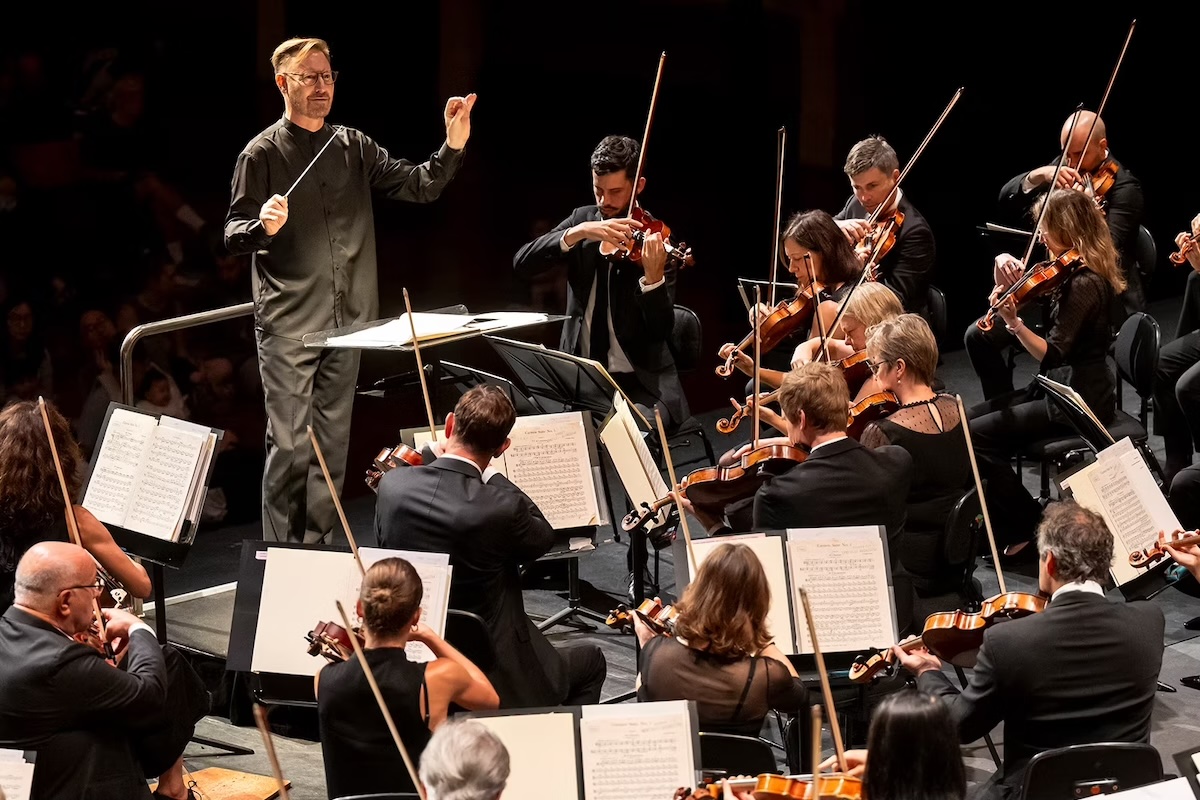
Benjamin Northey conducts musicians of the Sydney Symphony Orchestra. Photo supplied
Indeed in his warm and enthusiastic introduction, SSO conductor-in-residence Benjamin Northey mentioned a recent conversation with jazz trumpeter Wynton Marsalis in which Marsalis (who performed at Snow with the Jazz at the Lincoln Center Orchestra in August 2023) had described Snow as one of the world’s best new state-of-the-art performance spaces.
The capacity Canberra audience received the orchestra sincerely at the opening, and rapturously by the end of a surprisingly adventurous program.
Zoltán Kodály is certainly best known as the founder of a music education method still widely employed today, but was a serious, original and inspired composer. Kodály made a deep contribution to the preservation of Central European folk melodies.
Kodály’s five-movement Dances of Galánta (named for the town where he grew up) opened the concert – first with bright, optimistic grandness and then moving into folk tune-driven Romani dance tableaus. Gradually building tempos were executed with discipline, players leaning into syncopations and characterful swung phrases. The woodwind section was especially impressive here, with superb articulation and dynamic variation.
While Northey has a relatively conventional conducting style, he leads with energy and cheerfulness. Almost imperceptible pauses between movements kept the sense of pace up throughout.
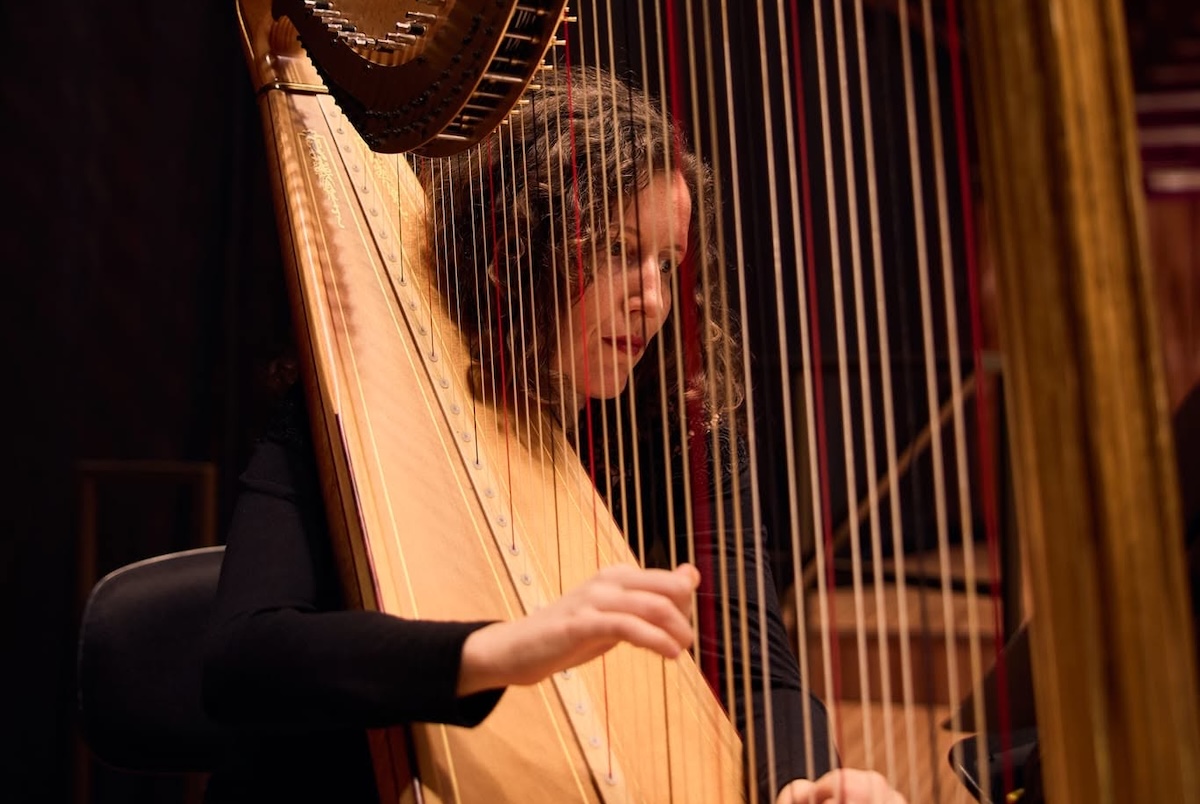
Louisic Dulbecco. Photo courtesy Sydney Symphony Orchestra
Louisic Dulbecco took centre stage with her spectacular instrument for Claude Debussy’s Dances for Harp and String Orchestra. The chromatic harp became the heart of the orchestra for the first (Sacred) dance, in Dorian mode to echo ancient church music. Dulbecco’s playing was delicate, but at the same time sounded out over the orchestra as she caressed wafting arpeggios and runs.
Striking the first notes of the runs very distinctly gave the harp a piano-like effect in punctuating phrases and emphasising new motifs. In the second (Profane) dance, there really wasn’t much profanity, but a brighter feel in Lydian mode.
As an encore, Dulbecco performed solo a Debussy Arabesque which again displayed a breathtaking ease.
Stuck at home during COVID lockdown Australian composer Holly Harrison was forced to endure night-time roadworks outside. But this inspired Hi-Vis: a clever, colourful, jazzy, fun, big band work interspersed with worksite sounds like whistles, sirens, hammers and drills. The SSO’s percussionists and brass provided the discord and clashes, while other sections contrasted with lovely harmonies.
To close, Igor Stravinsky’s ballet The Firebird – Suite began with huge delicacy and built to the bright energy of the Firebird’s dance – the trebly character of the oboes, clarinet, flute and horns predominant. The following movement’s percussive, cacophonous beginning transitioned into sensitively executed diminuendos and delicate phrases, with an especially beautiful bassoon solo.
Having played at forte-fortissimo only minutes earlier, the SSO strings playing at an exquisite pianissississimo temporarily paused all breathing in the hall.
After three curtain calls, Northey rewarded the house with an all-stops-out William Tell Overture (Rossini) to send everyone chirpily on their way.






Comments
Log in to start the conversation.