One wonders what Wagner would have made of Henk de Vlieger’s brilliant adaptation of the music of his operatic cycle Der Ring Des Nibelung. There is nothing in music literature that approaches Wagner’s epic gesamkunstwerke, with its tales of love, the illusory nature of power and the ultimate fall of the gods, universal themes that resonate today.

De Vlieger’s The Ring, a Symphonic Adventure was commissioned in 1991 by the Netherlands Radio Philharmonic Orchestra, of which he is a percussionist. ASO conductor Mark Wigglesworth notes how De Vlieger’s version offers audiences daunted by Wagner’s 16-hour, four-opera cycle a gateway into it.
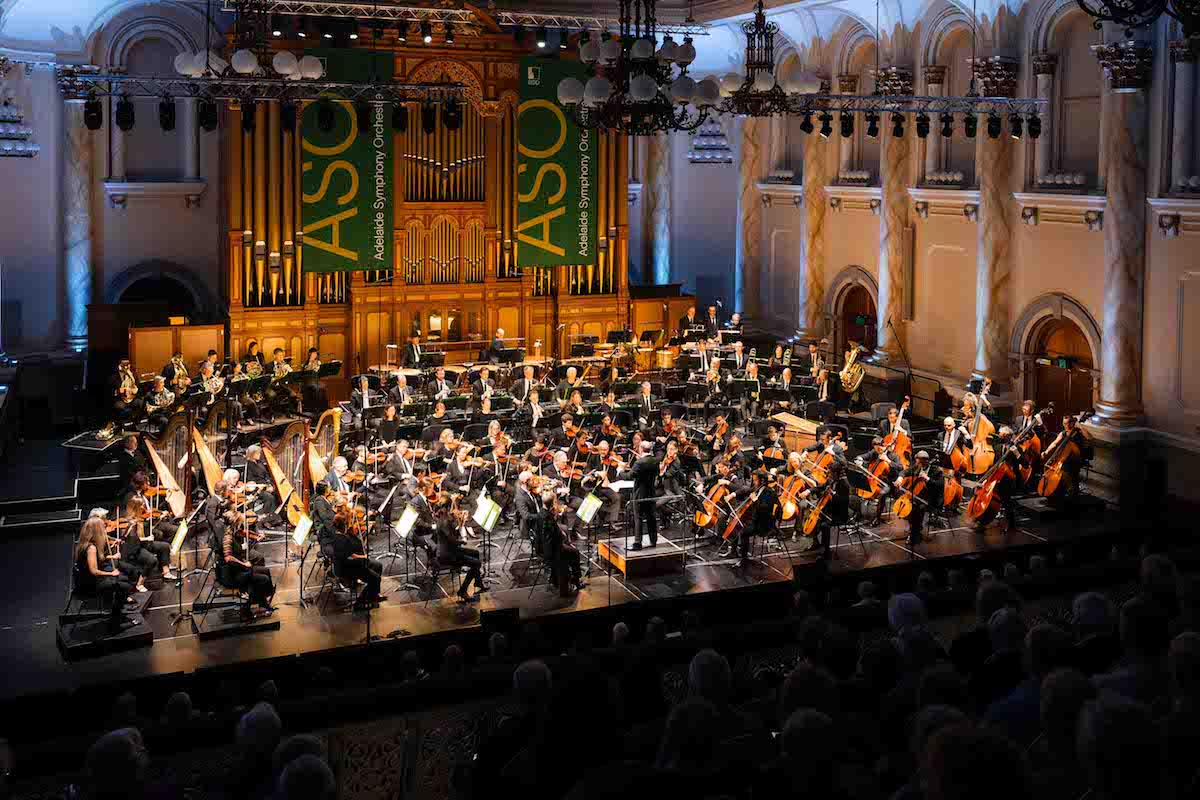
Adelaide Symphony Orchestra: The Ring. Photo © Jack Fenby

De Vlieger succinctly captures the essential elements of the operas’ plots by employing the leitmotifs Wagner created to identify the main characters and action. The Ring, a Symphonic Adventure comprises 14 elements, each named for their dramatic references, which are divided into four sections corresponding to the operas, but the music flows as a continuous whole in symphonic style. For audiences familiar with the operas, there will be vivid reminders of each of the scenes represented.

From the opera Das Rheingold, the Vorspiel (overture) sets the stage, and this section includes elements entitled Das Rheingold and Nibelheim and an evocation of Valhalla.

From the opera Die Walküre we hear the dramatic Ride of the Valkyries and Feuerzauber, and three elements from Siegfried, opening with the orchestral interlude Waldweben, featuring the rustling of the forest and chirping birds. There’s a long horn solo during which the orchestra sits quietly and then erupts into action and high drama in Siegfried’s Heldentat (heroic deed).

Finally, from Götterdämmerung, there is the romantic Siegfried and Brünnhilde theme and the work concludes with Brünnhilde’s Opfertat (sacrifice), when she rides her horse into Siegfried’s funeral pyre to redeem the world and bring down the hall of the gods.

Helena Dix, Adelaide Symphony Orchestra and conductor Mark Wigglesworth: The Ring. Photo © Jack Fenby

To recreate the drama and emotional impact of the original, massive orchestral forces are required, and the ASO’s brass section is augmented to reflect Wagner’s instrumentation, with nine horns, including Wagner tubas, a type he invented to fill a gap he perceived in brass instrumentation. The percussion section includes anvils that are hammered to evoke Nibelheim, the home of the Nibelungs — the music is at times quiet and at others overwhelming.

Though one can imagine the singers’ voices in the original, their absence does not detract at all from the music. The ASO’s performance is magnificent, particularly that of the brass and winds.

This thoughtful concert program of just two works opened with Richard Strauss’s Four Last Songs (1948) which emerged from a period of compositional activity very late in life at a time of his disillusionment at the destruction of World War II and especially the loss of opera houses where he had heard Wagner as a child and where his own operas had been staged.

Strauss’s masterpiece is beyond exquisite, perhaps the most emotionally intoxicating work in all music. It requires the utmost technical ability of the soprano, who, in rendering the poetry, must create a feeling of thoughtful intimacy while filling the auditorium. A large orchestra is required, and Strauss’s writing blends the soprano voice with strings and winds to create exquisite colours and textures.

The work sets four poems: Frühling (Spring), September and Beim Schafengehen (Falling Asleep), all by Hermann Hesse, and Joseph Von Eichendorff’s Im Abendrot (At Sunset) which ends:

O spacious, silent peace,

so deep in evening’s glow!

How travel-weary we are—

Could this perhaps be death?

Im Abendrot represents an elderly couple at the end of their lives who accept death peacefully. The last notes are quoted from Strauss’s Tod und Verklärung (Death and Transfiguration) written in his youth and thus suggesting the arc of his own life. He died the year after the work was completed.

Helena Dix, Adelaide Symphony Orchestra and conductor Mark Wigglesworth: The Ring. Photo © Jack Fenby

Soprano Helena Dix’s bel canto voice is superbly suited to the work, and her vocal performance was magnificent. But what turned a fine performance into an exceptional one was her use of facial expression – her acting ability – to convey the sentiments in the lyrics. The effect was breathtaking, greatly amplifying the emotional intensity of the music.

During concertmaster Kate Suthers’s exquisite violin solo in Beim Schlafengehen, Dix turned to her as if they were in conversation, and during the final bars of Im Abendrot, she similarly turned to engage with conductor Wigglesworth. As the piccolos representing ascending larks fluttered, Dix looked heavenward, the destination of the elderly couple represented by the larks. While De Vlieger turned Wagner’s music theatre into music, Dix subtly turned Strauss’s music into profound music theatre.

Wigglesworth’s tempi were judged perfectly, and Helena Dix’s control enabled the music to flow gently and unhurriedly in a most memorable performance.


The Adelaide Symphony Orchestra also performs The Ring on 30 May, Adelaide Town Hall.

Contribute to Limelight and support independent arts journalism.