


Bigger & Closer (not smaller & further away) is a remarkable standalone work, created by the late David Hockney, who passed away on 11 June this year, with London’s LIGHTROOM, a joint venture of London Theatre Company and the award-winning design studio, 59.
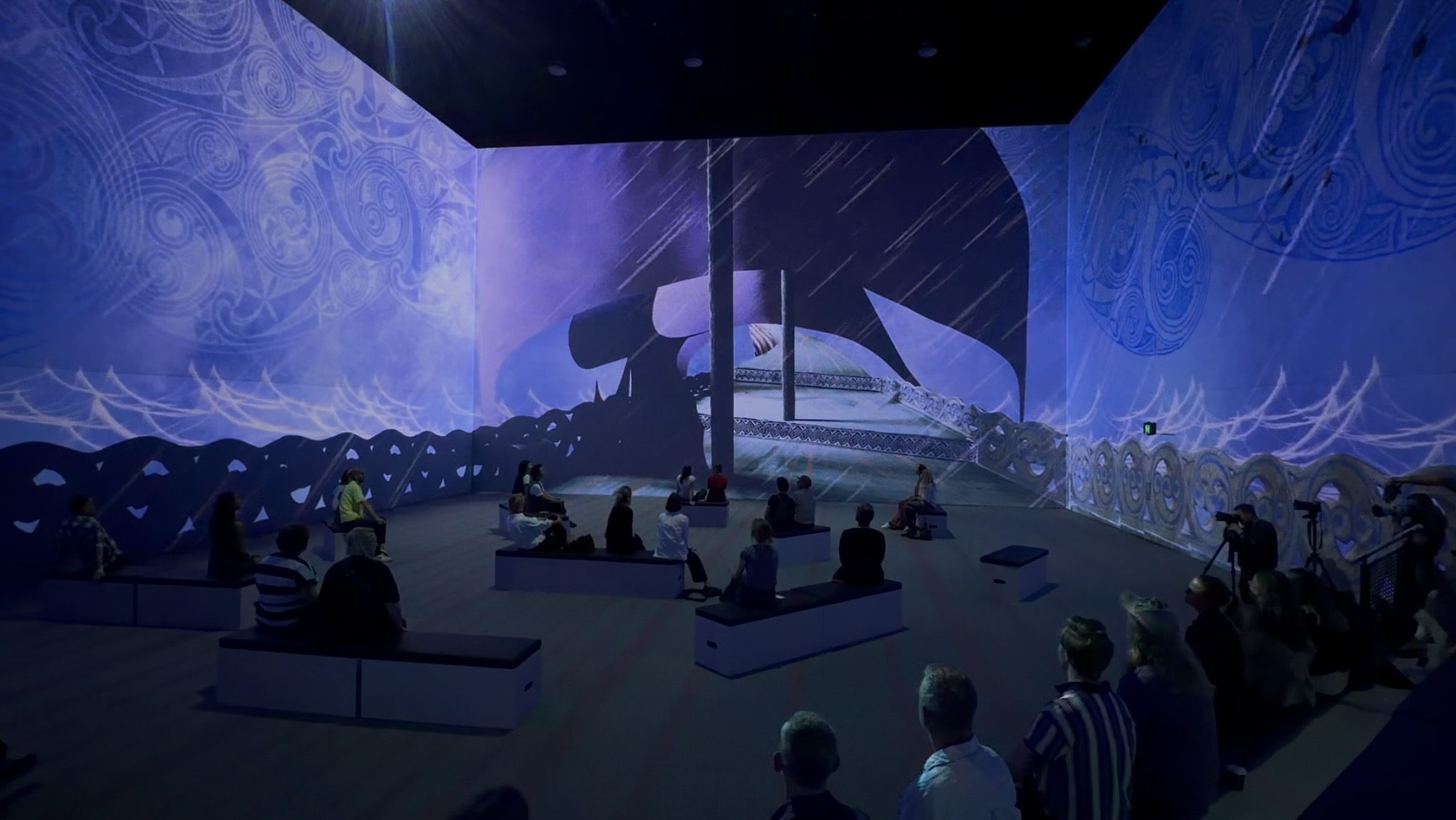
David Hockney’s set design for Act I of Tristan und Isolde in Bigger & Closer at Carriageworks. Photo © JJ Antmann
In some ways, it’s easier to explain what it isn’t than to describe what it is.
It’s no catalogue raisonné, nor a slavish attempt at documenting Hockney’s 60-year artistic journey from pioneering British Pop Artist to landscape painter and modern Master.
And it’s certainly not autobiographical. If it were, his arrival in the US would almost certainly be represented by his celebrated A Rake’s Progress series of etchings from 1961– 63, which could so easily have been brought to life in this 360-degree multimedia space.
Instead, Hockney takes us to California, where we find ourselves in the back seat of his convertible as he drives through the craggy Angeles National Forest filming his 2012 multi-camera work Wagner Drive, each panoramic reveal perfectly timed to the thunderclaps of the composer’s music.
Hockney’s voiceover notes how “the straight lines and cubes of LA” give way to the “squiggly lines of the LA hills”.
Later, he throws us into the deep end of Nick’s swimming pool from the eponymous 1966 painting, more squiggly lines now projected on top of us to evoke the ripples and kinetic energy of the water.
As the projection pans down and we rise to the surface, Peter Schlesinger’s bare bottom is revealed.
Elsewhere, a figure from Hockney’s 1965 painting California lies face-down on a lilo, and as we float through his swimming pool series, we arrive at his iconic A Bigger Splash from 1967.
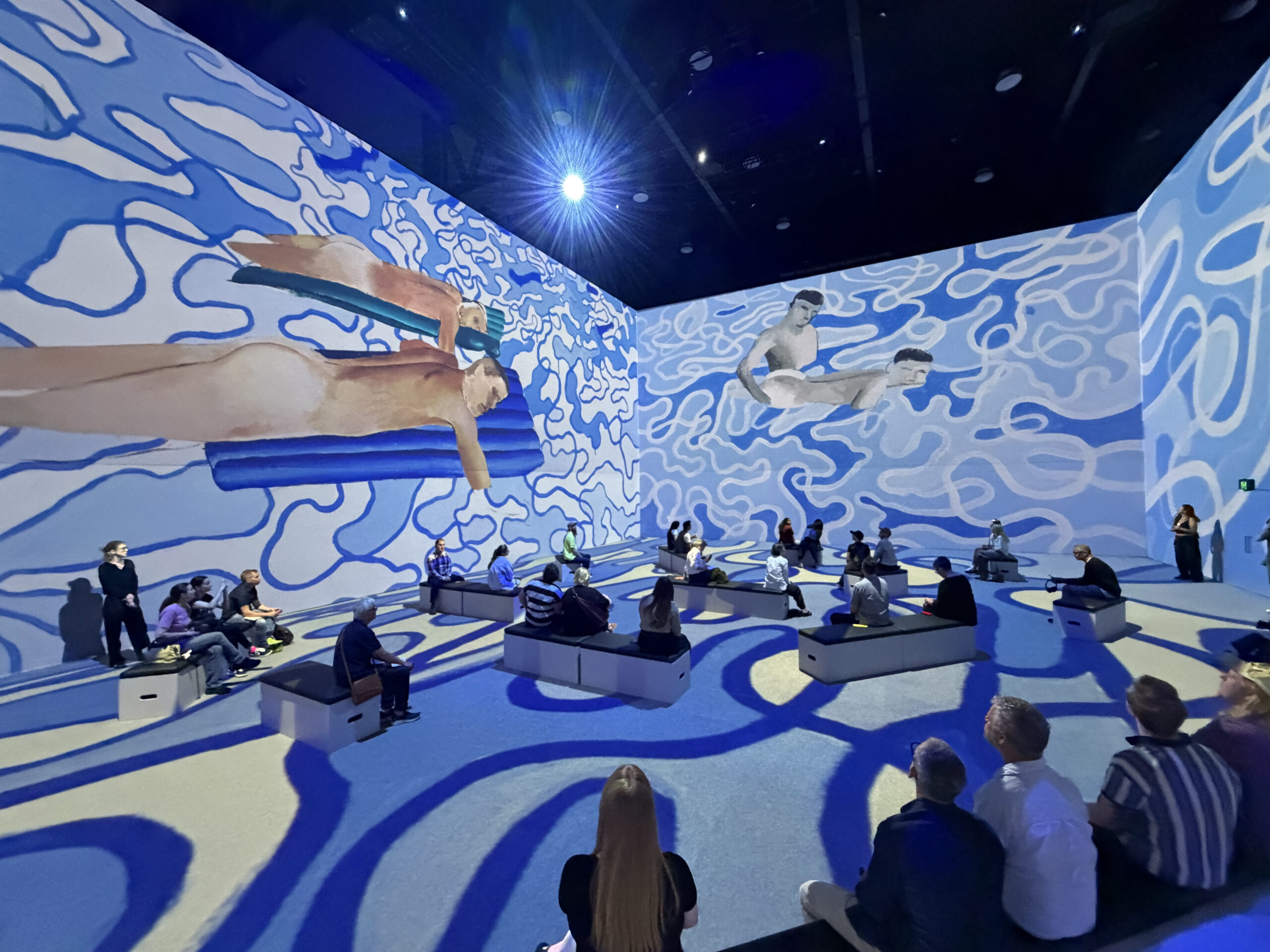
David Hockney’s California from 1965 in Bigger & Closer (not smaller & further away) at Carriageworks. Photo © JJ Antmann
None of the images are labelled. That’s not the point.
Instead, this painstakingly choreographed and highly theatrical presentation encapsulates with dazzling efficacy Hockney’s experiments in the representation of space, time and motion, the apotheosis of which is his landmark set design for Wagner’s Tristan und Isolde, created in 1987 for Los Angeles Music Center Opera (now LA Opera) with director Jonathan Miller.
“I’m a space freak,” Hockney says, adding, “My sister said, ‘Space is God.’”
From Brunelleschi’s formulation of linear perspective to the unfolding passage of time in Chinese scrolls, Hockney takes us through the way he synthesised and further developed these principles, from his multi-canvas and multi-planar works to Cubist-style photographic collages (his so-called “Joiners”) that simultaneously allow the viewer to appreciate different fields of vision, and time passing.
Then there is his fascination with nature, which provides him with an operatic canvas on which to address the themes of life, death, renewal and sex.
Thanks to the body of work he created with the Brushes app on his iPad, we witness ‘creation’ in the way simple dots and dashes are built up into sweeping landscapes that envelop us.
Capturing the four seasons in his Woldgate Woods series (both on video and in oil), he describes spring as “nature having an erection … it’s as if champagne has been poured over the bushes.” Earlier, he is quoted as saying, “You cannot look at the sun or death for very long,” but in his works he allows us to do just that.
When autumn comes, the floor beneath us is strewn with ochre leaves. In winter, the snow falls. And in another of his animated iPad drawings, the sun meekishly peers over the horizon before majestically rising, growing until we are completely bathed in its resplendent rays. It’s breathtaking stuff that places us within the canvas, no longer viewers but participants in Hockney’s art.
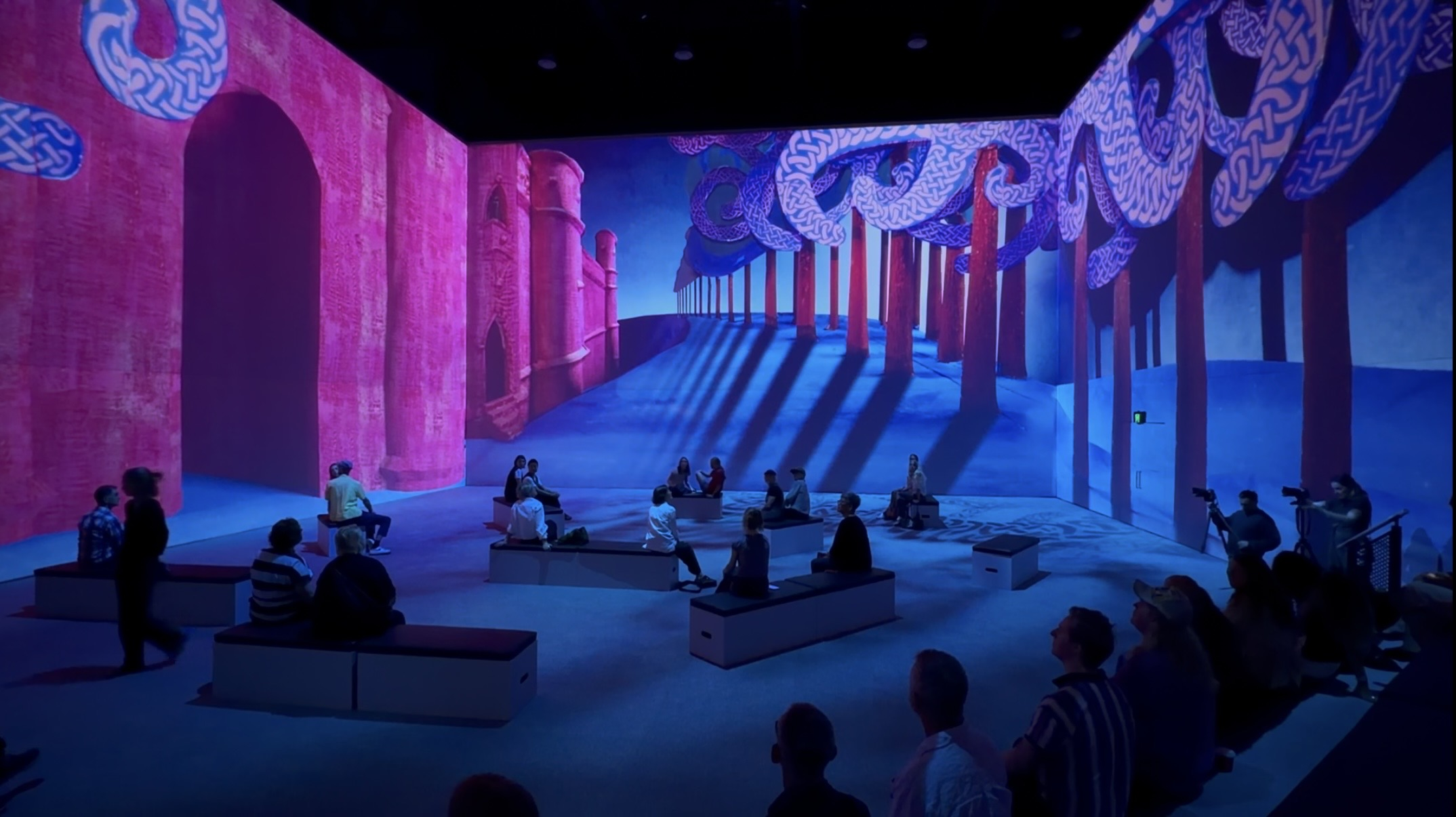
David Hockney’s design for Act II of Tristan und Isolde in Bigger & Closer … at Carriageworks. Photo © JJ Antmann
This is never more potent than in the recreation of his set designs for Tristan und Isolde, where we find ourselves ‘on stage’ as it where – on the storm-ravaged deck of Tristan’s ship, in the night garden outside King Marke’s castle and on the clifftop in Kareol. It’s worth the price of a ticket alone.
Rain falls, the shadows of the Celtic grove move across the lawn as the moon crosses the night sky, and as these otherwise static scenographic elements are brought to life, we come to appreciate how Hockney’s judicious use of lighting alters the depth, scale and tone of the environments he created.
Perspective is fundamental to set design, and Hockney understood this better than anyone. However, as he says, “Nature doesn’t follow the rules of perspective,” and it is this dichotomy in his work that lends his theatre designs their unmistakable, almost hallucinogenic edge.
Alongside Tristan und Isolde, we are treated to humorously animated designs for Stravinsky’s The Rake’s Progress from 1975 (still the jewel in Glyndebourne’s crown); The Magic Flute in 1978; his two 1981 triple bills for the Metropolitan Opera – Parade comprising the titular ballet by Satie, Poulenc’s Les Mamelles de Tirésias and Ravel’s L’Enfant et les Sortilèges, and a Stravinsky program including The Rite of Spring, Le Rossignol and Oedipus Rex; and finally Turandot for Lyric Opera of Chicago and San Francisco Opera in 1991.
Those of us who fondly recall seeing Hockney’s sets for Richard Strauss’s Die Frau Ohne Schatten when it was conducted by Simone Young as part of the 1996 Melbourne International Festival of the Arts will no doubt lament its omission from the lineup here, but Hockney was wise not to include it. Stylistically, it straddles Tristan und Isolde and Turandot, and wonderful though it is, it would obscure their uniqueness.
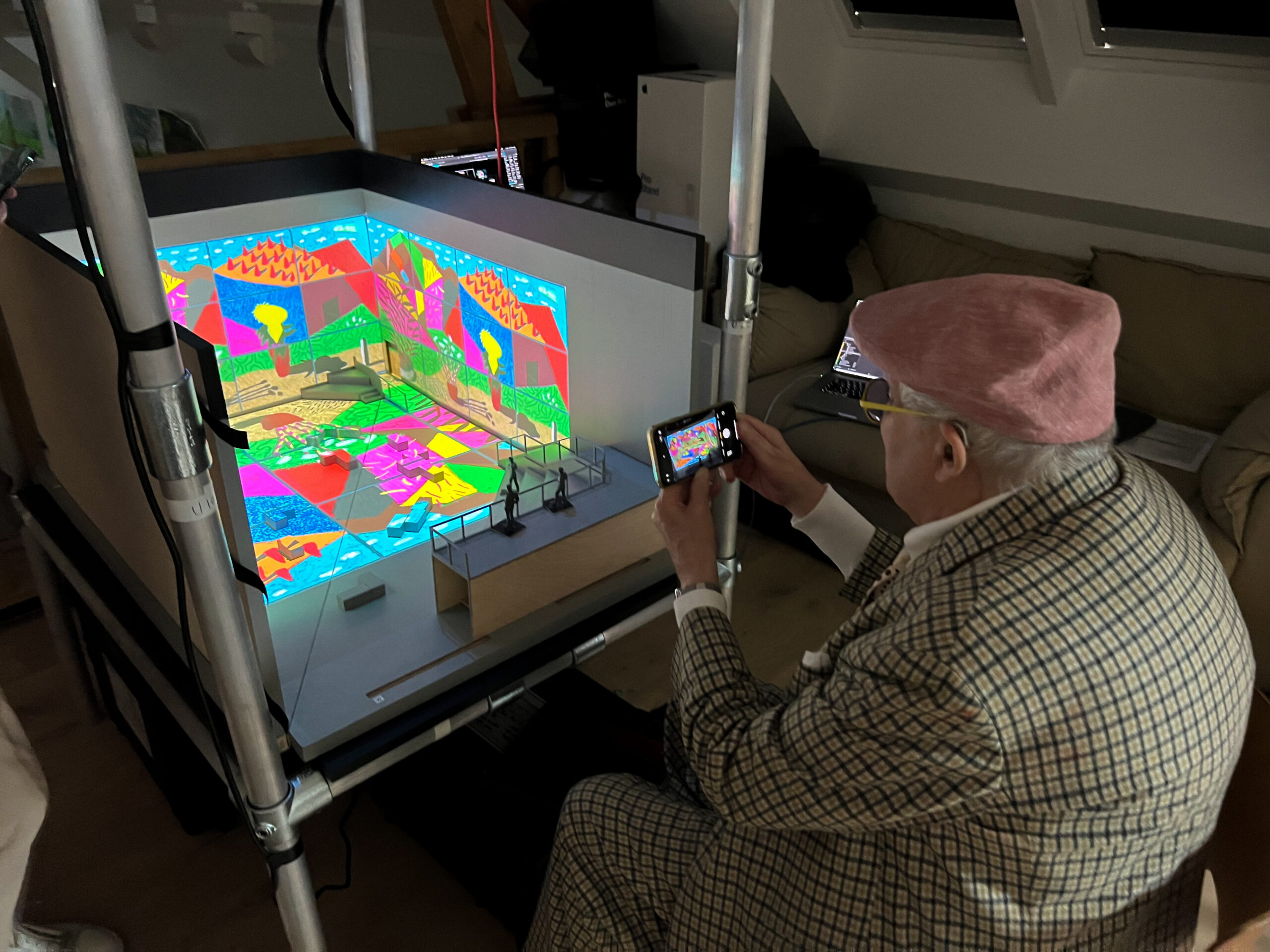
David Hockney working on Bigger & Closer … Photo by Justin Sutcliffe © David Hockney
Musically, apart from the obvious selections from the composers already mentioned, the task of underscoring Hockney’s genius falls to Nico Muhly, who has composed a suite divided into five movements: Perspective Lesson, Roads and Paths, Drawing with a Camera, Looking Closely and Pools.
What appear to be lightly bowed strings, seemingly played flautando, give way to an actual flute, but where the two meet is magically obscured in this shimmering soundscape that features Muhly on celesta and piano.
Delicate sounds like dew drops evoke Hockney’s brushwork, coming together in a complex tapestry that develops with a pulsing undertone as Roads and Paths gathers momentum.
Copland-esque figures emerge in Drawing with a Camera, capturing the wide openness of Hockney’s landscapes, in particular his Grand Canyon works, while Looking Closely reveals Muhly’s particular gift for marrying contrasting string textures.
Nothing is muddy or blurred, Muhly’s score remaining transparent throughout – just like the crystal-clear waters in Hockney’s swimming pools.
Hockney loved Wagner, and it is fitting that this final, immersive showcase of his genius is itself a Gesamtkunstwerk.
David Hockney: Bigger & Closer (not smaller and further away) is at Carriageworks, Sydney, until 24 January, 2027.





Comments
Log in to start the conversation.