


The wheel has turned full circle with Pinchgut Opera’s presentation of Handel’s three-act opera Semele, which was the company’s debut production in 2002, conducted then by Antony Walker and directed by Justin Way.
The scandalous themes of Semele are as relevant today as they were in 2002 and even in February 1744, when it premiered at Covent Garden as an oratorio. Although William Congreve’s libretto derives from Ovid’s Metamorphoses, Semele’s story could be any current headline about the dark use of power and privilege, fandom, ambition, sex and betrayal.
Curiously, it was presented during Lent, no small reason for its lukewarm reception among those seeking a spiritual experience or an Italianate opera. Handel designed it “in the Manner of an Oratorio”, performed in concert. There were just four performances in February and two more in December at the King’s Theatre, with the inclusion of Italian arias and the omission of more sexually explicit content.
Semele was not performed again during Handel’s lifetime. Revived in Cambridge in 1925, Semele had its London stage première in 1954; the (then) Sadler’s Wells Opera presented it in 1970 and Covent Garden in 1982, both productions conducted by Sir Charles Mackerras.
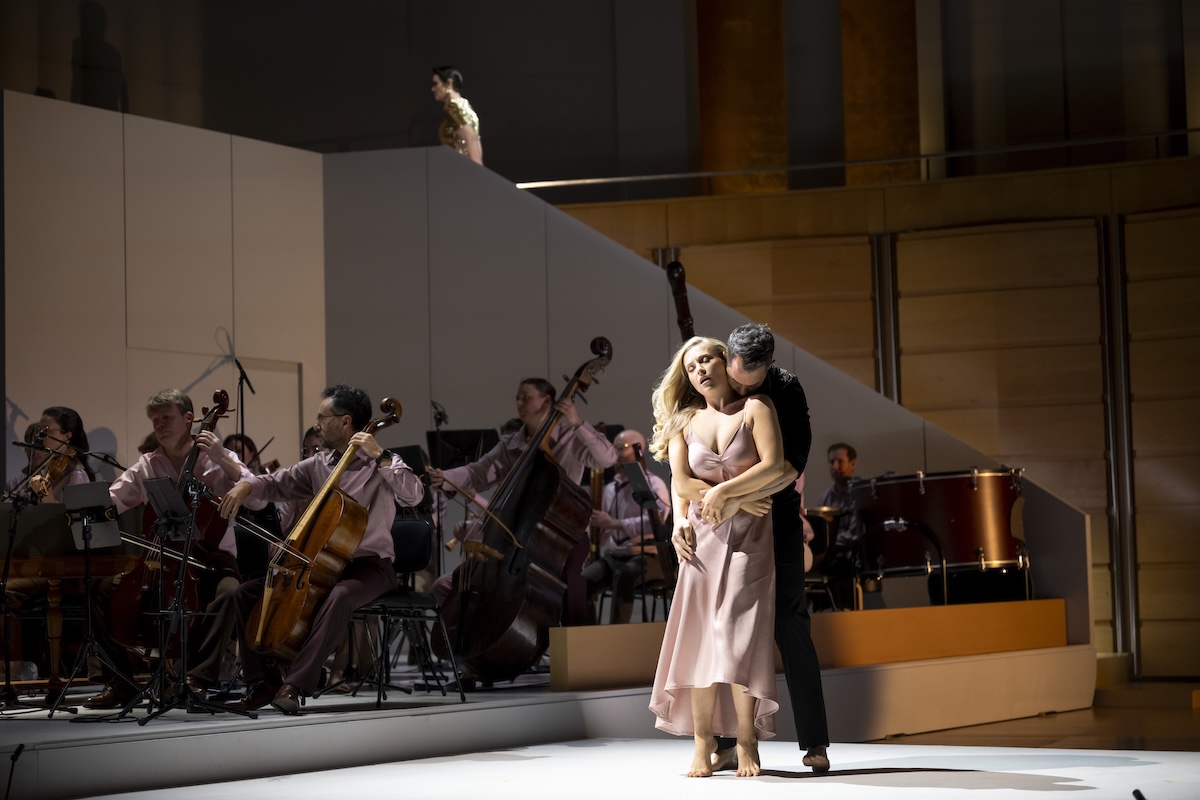
Alexandra Oomens and David Webb in Pinchgut Opera’s Semele. Photo © Cassandra Hannagan
Semele has all the richness of English oratorio, Italian passion and Greek tragedy. Director Neil Armfield and his team of creatives, along with Erin Helyard, directing the gilt-edged musical cast from the harpsichord, have shaped a brilliant piece that draws the emotions, explores the nuances and ultimately entertains.
Handel’s luscious score is honoured with the placement of the 25-strong orchestra on stage. At first sight, this markedly reduces the performance space, but I am ever surprised and impressed by how Pinchgut’s stage designers work wonders with the minimal theatrical resources of a recital stage.
Designer Dale Ferguson’s inclusion of different platforms, stairs, balconies, the auditorium and a massive video screen creates new spaces for the narrative. The costumes are stylish in shades of taupe and soft pink; soloists wear individual colours consistent with their characters.
Handel’s music spoils us with its riches. Arias, accompanied and secco recitatives, sinfonias, choruses and ensemble pieces feature grand polyphony, dances and word-painting that cuts to the core. It is some of the most touching and exciting music he composed. His economy of writing says so much with so little.
There are some omissions, such as Hymen, haste! thy torch prepare!, but some interesting restorations as well, such as Cupid’s Come, Zephyrs, come, an aria that Handel rejected and never performed.
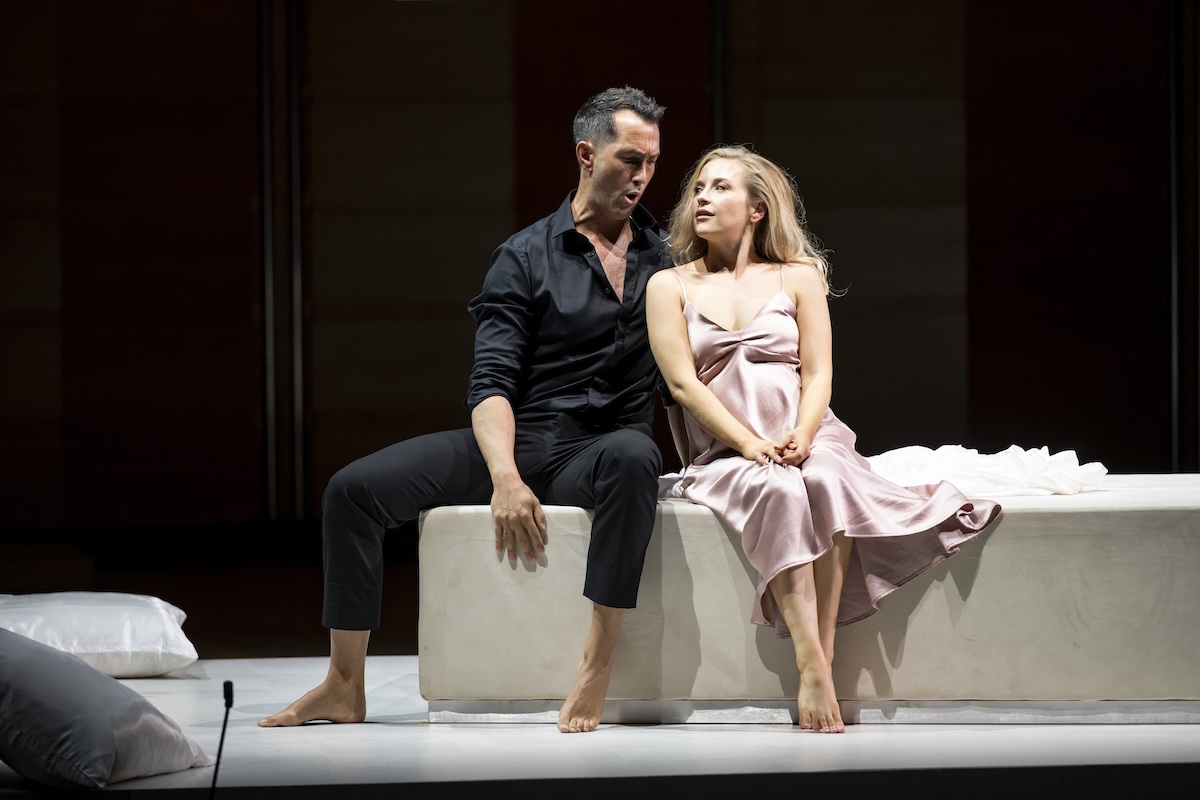
David Webb and Alexandra Oomens in Pinchgut Opera’s Semele. Photo © Cassandra Hannagan
The cast is outstanding. As Semele, Alexandra Oomens is almost constantly on stage and brings fearless, lissom physicality and inexhaustible energy to her portrayal. A trembling and reluctant bride to Athamas, she is fired by insatiable desire for Jupiter, deliriously vain in her showstopping number Myself I shall adore, ecstatic in the evergreen Endless pleasure and haughtily insouciant in I ever am granting.
Her moments of introspection (Ah! Me too late I now repent) and her death scene elicit sympathy rather than disdain. Her coloratura shimmers, there is ample depth in her chest voice and great beauty in between.
Playing her dastardly lover Jupiter is British tenor David Webb. Buffed and dapper in black, he seduces and distracts Semele, eventually becoming remorseful that he has caused her demise. There is great lyrical beauty in Come to my arms, my lovely fair.
The heady ‘nature’ aria Where’er you walk (words by Alexander Pope) is straight-toned and exquisitely sung. The da capo section is judiciously ornamented with simple elaboration rather than the fireworks we hear in the quickfire coloratura of I must with speed amuse her.
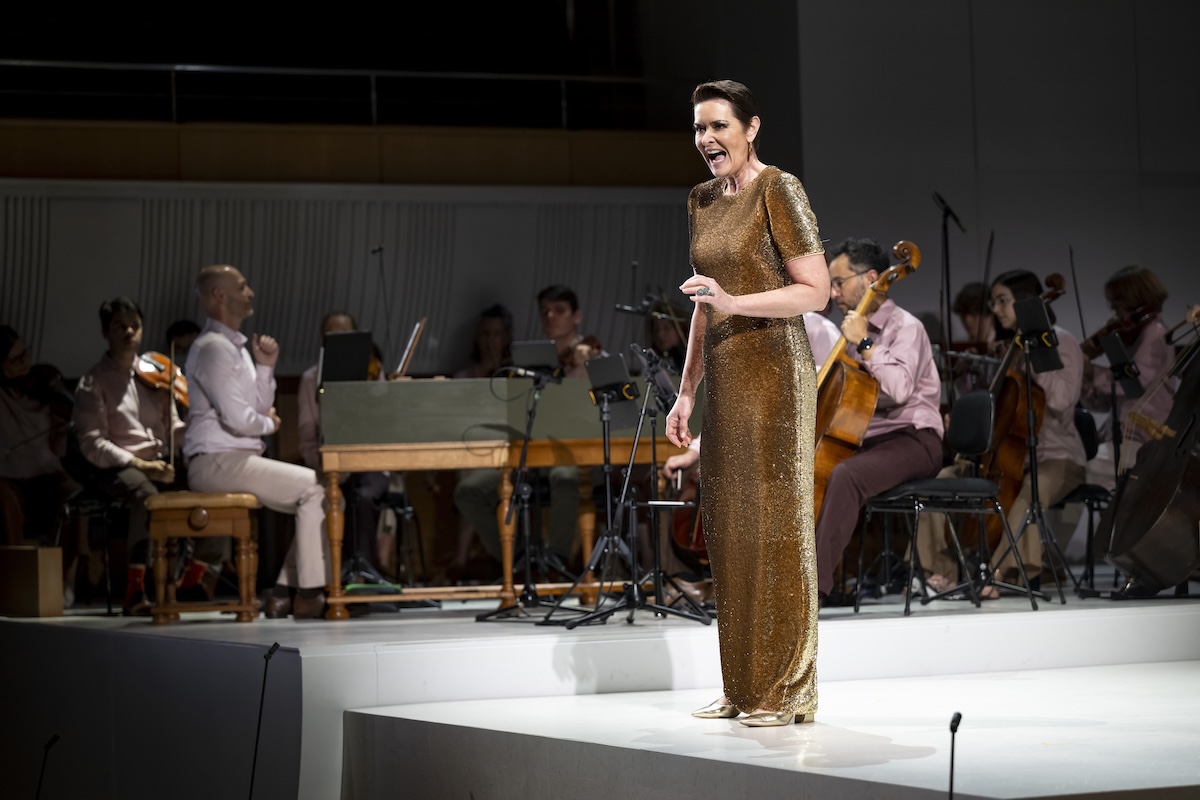
Catherine Carby in Pinchgut Opera’s Semele. Photo © Cassandra Hannagan
As Juno, Catherine Carby is outstanding; her aria Hence, Iris, away is a crowd-pleaser. Statuesque and swathed in gold, she is vocally excellent and malevolent, with a touch of comedy in her banter with Iris, her attendant, sung beautifully and also layered with humour by Myriam Arbouz, whose antics brought smiles to all but the dour Juno.
The smaller solo roles are adroitly accomplished by Hannah Fraser as Ino, Austin Haynes as Athamas, Sebastian Maclaine as Apollo and Nicholas Dinopoulos as Cadmus. Andrew O’Connor entertains as the curmudgeonly man-child Somnus. Perhaps there could have been more play with lighting in this scene. There are welcome roles for Pinchgut Opera scholars Freddie Shaw, richly sonorous as the High Priest, and Izabelle Zammit, glorious in voice as Cupid.
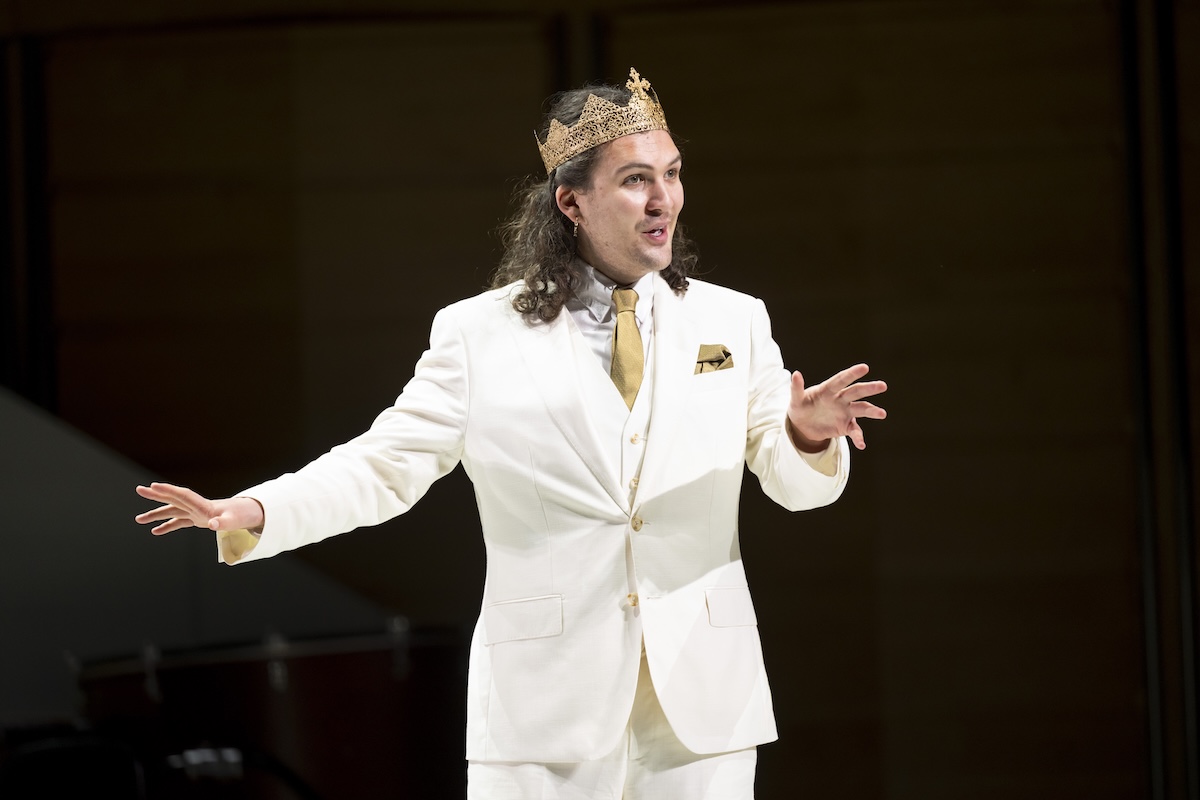
Austin Haynes in Pinchgut Opera’s Semele. Photo © Cassandra Hannagan
The chorus of eight, augmented by the soloists in smaller roles, is in full voice, at times forming part of the action on stage and at others commenting on it from the balcony. They produce a thrilling sound in some of Handel’s most dramatic (Oh terror and astonishment) and richly polyphonic (Attend the pair) choruses.
Semele is a story begging to be dramatised. Armfield, Helyard and their teams have given us a sublime production about which so much more could be said. Better still, see it for yourself. It might be another quarter-century before you get the next chance.
Pinchgut Opera presents Semele at City Recital Hall, Sydney until 2 December.







Comments
Log in to start the conversation.