It has been reported that Thea Musgrave (b. 1928), whose music was featured in this concert, once responded to an interviewer’s question about being a woman composer by saying, “Yes I am a woman, and I am a composer. But rarely at the same time”.
The Adelaide Symphony Orchestra’s She Speaks programs, showcasing current and past women composers, bring to light underacknowledged women composers and engaging compositions. In her introductory remarks, composer Anne Cawrse noted that, over its four iterations since 2021, the She Speaks seasons have featured 77 works by 43 composers from 14 countries; 61 percent of the featured composers were still living and 23 were Australian. Four of the works on this concert program (besides her own) had not previously been performed in Australia.
Such emphasis on contemporary female composers greatly expands the nature and character of music presentation. Mounted in collaboration with Adelaide University’s Elder Conservatorium, the She Speaks concerts diverge significantly from typical orchestral programming in that they comprise shorter works, and these are often of a more personal nature, frequently offering profound insights into human society and especially the situation of women.
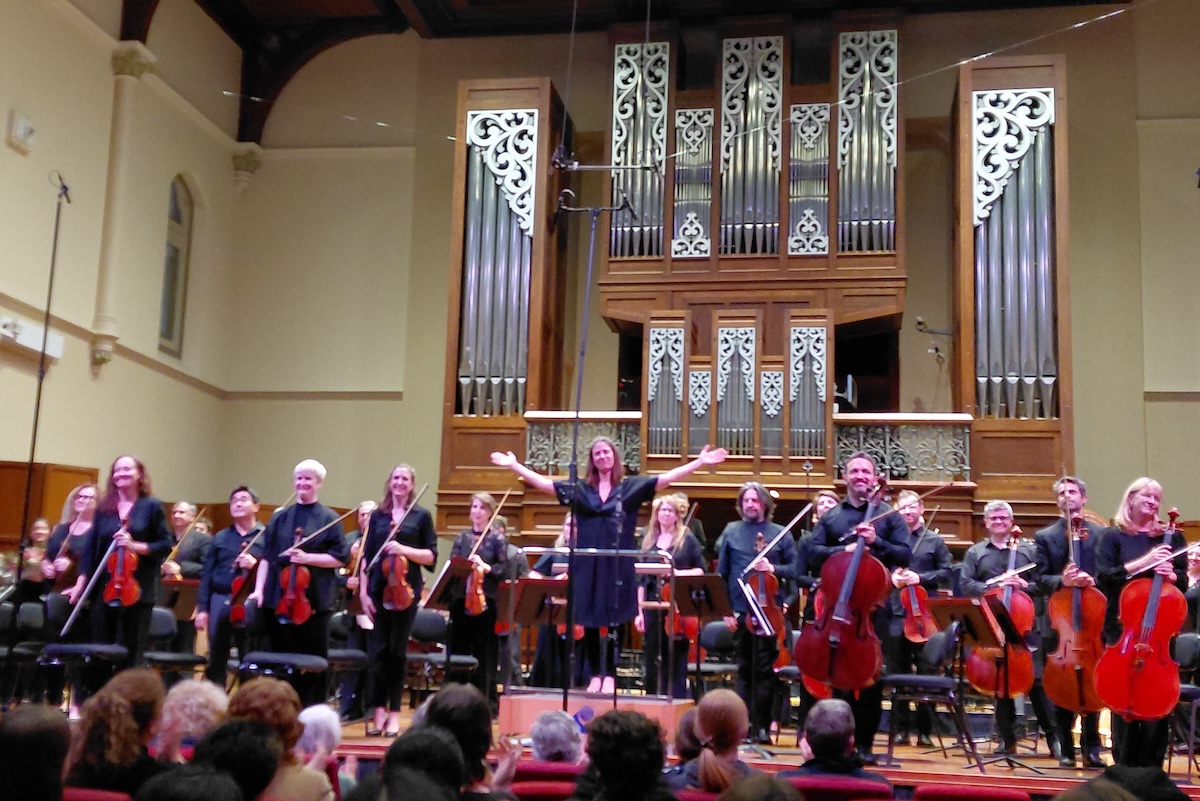
ASO’s She Speaks Concert 2 with conductor Sara Duhig. Photo © Chris Reid
The concert opened with Polish composer Grażyna Bacewicz’s (1909-1969) magnificent Overture, which was written in 1943 during the Nazi occupation of Poland, a time in which she gave concerts in secret. Thought to be her first orchestral work, it’s vibrant, defiant and uplifting. The timpani beating the Morse code signal for ‘V’ for victory can be heard, so it’s a rallying cry encouraging fortitude in the listener.
But while Bacewicz, who studied composition with the legendary Nadia Boulanger, was recognised as an outstanding violinist, she struggled for recognition as a composer in her environment.
Next, we heard Grace Evangeline Mason’s (b. 1994) Upon Weightless Wings (2018) for chamber ensemble, which is in three movements – In Sheep’s Clothing; and, between light and darkness; and To Breathe Now – each of which is her response to a related visual artwork. Mason states that ” … the piece explores themes of liberation; transitioning from darkness to light, restrain to freedom. It is a work written to celebrate new beginnings, to have weightless wings.”
It’s a contemplative and quite moving piece, with finely orchestrated interplay between strings and winds. The third movement, To Breathe Now, opens with dreamy violin harmonics and piano, there is a horn call, and the final bar is unresolved, leaving a question for the listener.
Cawrse’s The King Walks in the Orangerie (2024-25) for tenor and string orchestra, is a setting of the poem of that name by Canadian-born Australian poet Kathryn Purnell (1911-2006), who encouraged women writers and who managed caring for her sick husband and her family while writing.
Purnell’s epic poem imagines the ghost of French king Louis XIV (1643-1715) walking in the Versailles Orangerie (not to be confused with l’Orangerie in Paris, now an art gallery) which was built to house fruit trees in winter. He talks of his life, his wives and mistresses, his descendants’ lives and his delights and regrets.
Cawrse is well-known for composing for the female voice, and this superb setting for tenor — the wonderful Kyle Stegall in this performance — adds to her oeuvre. Setting it for tenor rather than the kind of regally declarative baritone that might be heard in an opera emphasised the introspective nature of the text.
Purnell makes sharp observations on monarchy and politics that resonate today. Unfortunately, the text was not included in the concert program, but her poem opens thus:
Mine is a tired ghost well acquainted with questions
still unsolved; consciously dissatisfied; harried
by avoidable mistakes; dismissing other ethical torts
of my historic times.
Stegall brought out the wide emotional range of the poetry and combined wonderfully with the ASO strings to create the intimate atmosphere suggested by Cawrse’s fabulous new work.
Anna Clyne’s Within Her Arms, for string orchestra, was written in memory of her mother who died in 2008. Slow and quiet, it’s a profoundly moving and deeply felt characterisation of love and grief, and listeners who have suffered loss will find their own emotions portrayed within it.
Thea Musgrave’s Night Windows, written in 2007 for oboe and piano and scored in 2016 for oboe and strings, was inspired by Edward Hopper’s haunting painting of the same name. Musgrave also studied with Boulanger.
It’s in five short movements, respectively entitled Loneliness, Anger, Nostalgia, Despair and Frenzy, each representing the kinds of emotional states that can be read from Hopper’s painting. Essentially a concerto, it’s a brilliant showcase for the oboe and ASO principal Joshua Oates was at his very best as the soloist.
The final work was Imogen Holst’s (1907-1984) Persephone (1929) for orchestra. Evidently, it’s a student work and there are passages that seem influenced by Ravel’s Daphnis and Chloe, but it’s a fine orchestral piece that captures the duality of the myth of Persephone, who was both goddess of spring and nature and queen of the underworld. The daughter of Gustav Holst, Imogen was better known for her educational work, festival administration and as her father’s biographer, and her compositions are rarely heard.
The conductor for this concert was Perth-based Sara Duhig, who is a participant in the 2025/2026 Australian Conducting Academy, and her leadership in the orchestral works was outstanding.
The first concert in this She Speaks season, held on 19 June, was given by members of the Elder Conservatorium’s Ensemble Lumen, with fine works by Reena Esmail, Anna Thorvaldsdottir and Amy Beach. Anne Cawrse’s comments raise the question of whether the She Speaks concerts might become redundant if regular orchestral programming embraces women composers more fully.
But even if that were to occur, the She Speaks programs bring to light a wide range of composers and types of works, enriching musical culture and encouraging innovation, experimentation and personal expression. Long may they continue.
For more information on Adelaide Symphony Orchestra in 2026, visit aso.com.au

Comments
Log in to start the conversation.