Ever since Leah Purcell first read Henry Lawson’s 1898 short story, The Drover’s Wife, she has been, shall we say, obsessed with the piece. The writer Frank Moorhouse described the longevity of the story in Australian culture as “a phenomenon unique in the Australian artistic imagination – the drover’s wife has become our Mona Lisa”.

Several writers have produced their own versions of it; Russell Drysdale painted the famous picture of the drover’s wife; and Moorhouse’s last book, published in 2017, carried the same title and featured Drysdale’s painting on the cover of a collection of essays dedicated to “drover’s wives”.

No one, however, has worked and reworked the archetypal story as extensively as Purcell: the celebrated Indigenous actress, playwright, director and novelist. She wrote and starred in the award-winning play in 2016. Her novel, The Drover’s Wife: The Legend of Molly Johnson, which dramatically extended the story, was published in 2019. She was writer, director and co-producer of the 2021 film adaptation of the novel. And in May, the opera, composed by George Palmer and directed by Purcell, had its world premiere in Brisbane. On Friday, it opened in Sydney.
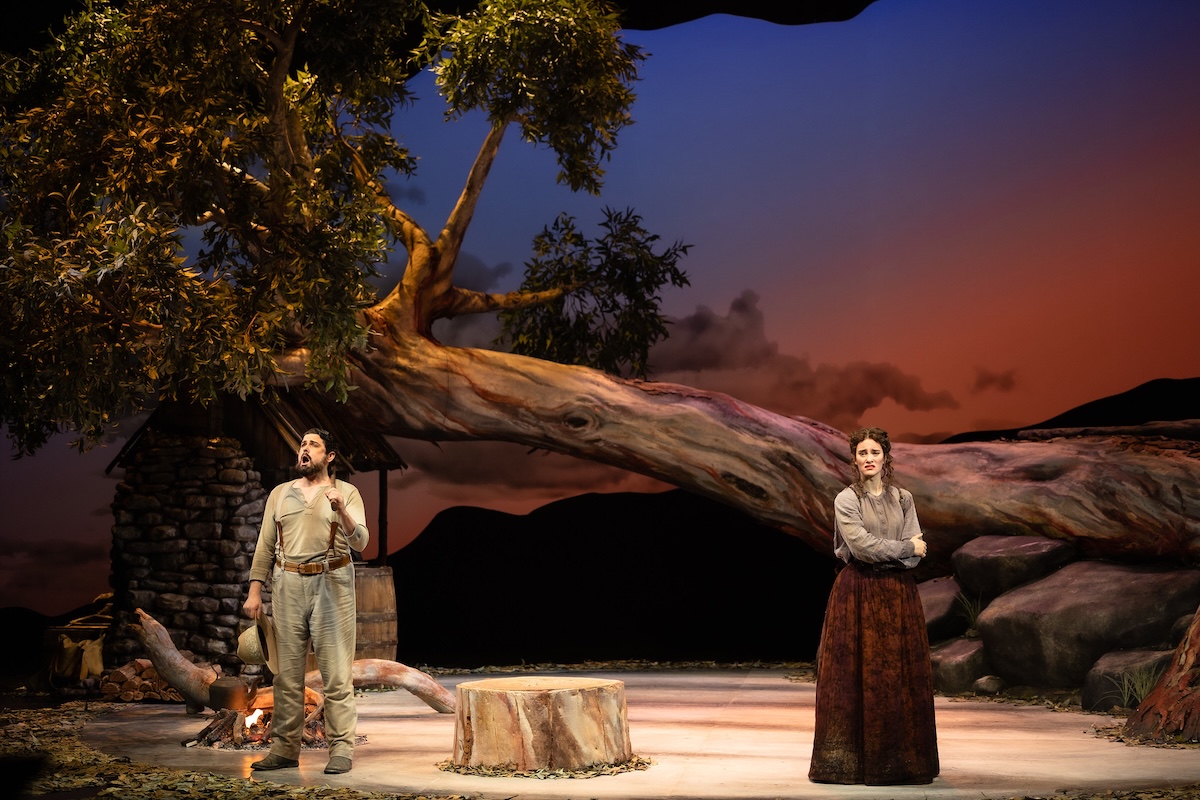
John Longmuir and Nina Korbe in Opera Australia’s The Drover’s Wife 2026. Photo © Carlita Sari

As soon as you enter the Joan Sutherland Theatre at the Sydney Opera House, you can tell something monumental is pending. The set, designed by Isabel Hudson, is dominated by a giant snow gum slanting horizontally, as though toppled by an alpine blast. It spans a natural mound of rocks on one side and a ramshackle cottage with a high stack of firewood and a forecourt of bare earth on the other. Indigenous performers come on stage, quietly stamping, singing and striking clapsticks, clad in pale, wraithlike garments designed by Tess Schofield.

Later, heavily pregnant with a fifth (living) child, Molly Johnson is doing it alone with four young children while her husband is away droving. She constantly tries to keep that forecourt swept, tidying the children’s world while taking care as rough men come and go. Among them is Yadaka, a man who initially seems frightening but proves less dangerous than expected. When she’s not holding a broom, she seems to be holding a gun.

Molly is one of the two central First Nations singers in the opera. Nina Korbe, a Koa, Kuku Yalanji and Wakka Wakka woman, completed her master’s in music at London’s Royal College of Music. She is a wonderful soprano, warm and sinuous, with dazzlingly clear high notes and an earthy lower register that moves easily between love, pride and fear.

Nina Korbe in Opera Australia’s The Drover’s Wife 2026. Photo © Carlita Sari

Yadaka is played by Marcus Corowa, a Bundjalung and South Sea Islander tenor. He has escaped from an unjust arrest for murder. Molly is uncertain about him, but helps him hack off his chains, and he eventually helps her on the farm, including with the burial of her stillborn baby. Corowa is an equally assured singer, his calm tenor underpinning his character’s emotional strength. Both performers are convincing actors and gradually weave an intimacy that is tinged with romance.

Molly’s eldest son, Danny, spends a great deal of time on stage too. Though Nick Smith’s acting doesn’t seem quite as assured, he is portraying a teenage boy developing under Yadaka’s guidance, including learning the use of weapons. His comfortable light baritone carries him through that maturation.

Marcus Corowa and Shane Lowrencev in Opera Australia’s The Drover’s Wife 2026. Photo © Carlita Sari

This is Palmer’s second opera. He suggested the work to Purcell after reading her novel and then wrote the libretto in collaboration with her. His music is lyrical, at times approaching the cinematic as the operatic action ebbs and flows. In places it seems less an accompaniment to the singing than a stand-alone environment, like wild weather surrounding the action.

As well as the dynamism of the Opera Australia Orchestra, Palmer and Purcell wrote for Indigenous voices and clapsticks, and the libretto for the non-white singers is in Walgalu as well as English. The Indigenous dancers come and go in ways that cohere beautifully with the narrative (unlike so much dance inserted into opera), preparing for and then underlining the story’s denouement.

Shauntai Abdul-Rahman, a composer herself as well as a multi-faceted Wiradjuri singer, brings a smouldering voice and strong stage presence to her Opera Australia debut. And if you don’t already know Purcell’s most recent telling of The Drover’s Wife, wait as the performance unfolds and it gradually dawns on you – as it dawns on Molly – who Abdul-Rahman’s deeply emotional character, Black Mary, really is. It’s a powerful evening.


Opera Australia presents The Drover’s Wife in the Joan Sutherland Theatre, Sydney Opera House, on August 11 and August 15.

Contribute to Limelight and support independent arts journalism.