Our most universal experiences are births, deaths and marriages. Oh, and let’s not forget war. They are the mainstay of mythology, the news cycle and art. They bring structure to our lives – ubiquitous rites of passage celebrated and commemorated time and time again, religious or secular but almost always theatrical.

Director Imara Savage and her creative team (set and costume designer Charles Davis, lighting designer Alexander Berlage, sound designer Benjamin Carey) latch onto this idea, setting Liza Lim and Barrie Kosky’s opera The Oresteia in a hyper-realistic funeral parlour that apes the proportions of European court theatres and the rigid geometry of Carlo Galli Bibiena’s 18th-century colonnaded stage designs.

In doing so, they reflect the work’s reduction of the House of Atreus’s tangled motives to their emotional core, conjuring a liminal space in which the funeral parlour becomes an abstraction – a threshold between the secular and the divine, where the living and the dead meet in acts that are at once theatrical and ceremonial.
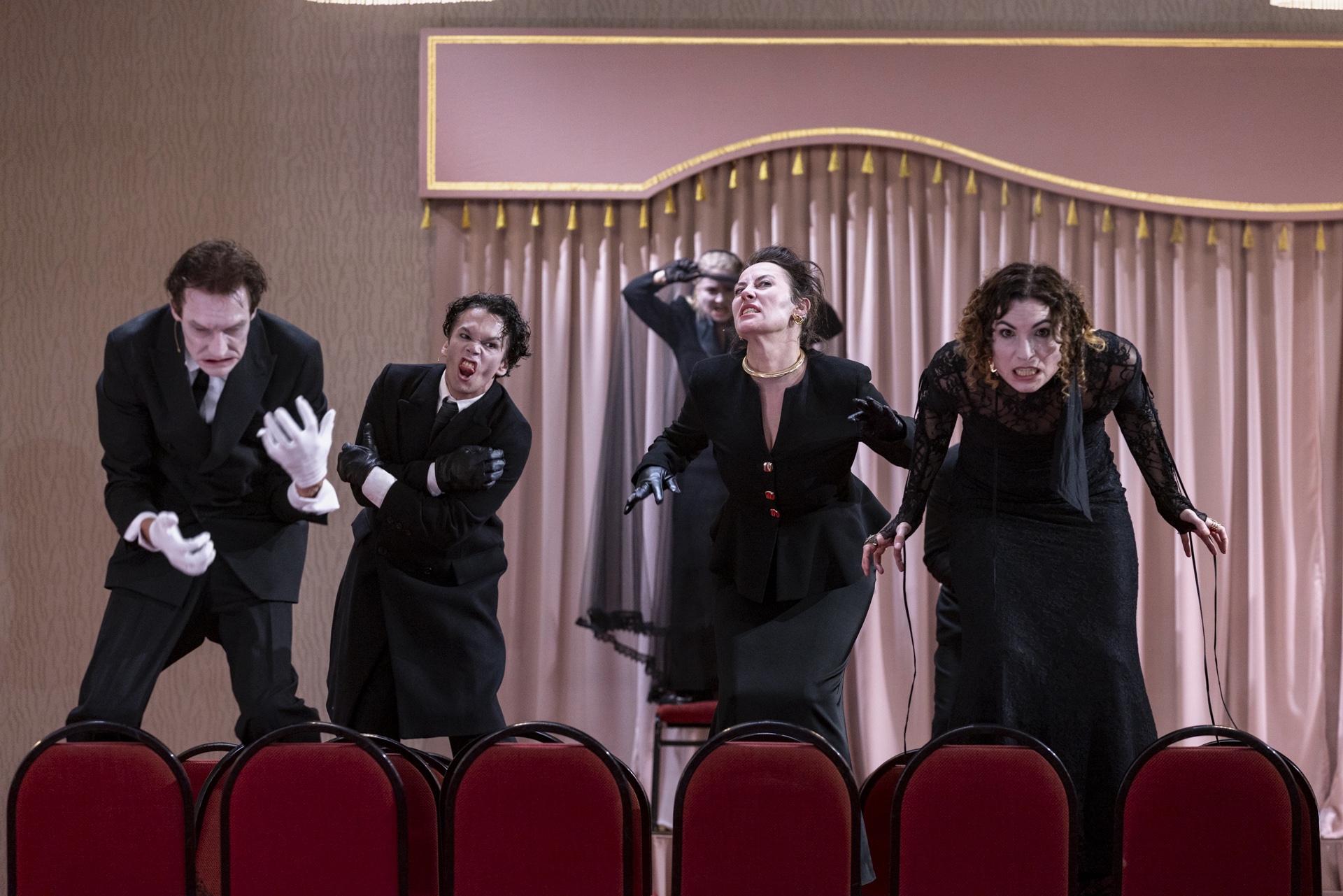
Sydney Chamber Opera’s The Oresteia 2026. Photo © Brett Boardman

During the pre-show, the performers are already on stage in mourning attire, sobbing and muttering, their repressed hysteria erupting in sudden, wild gesticulations.

Lim’s score is rooted in the perplexingly tangible yet indescribable sound of grief. Lim refers to it as “mouthfeel” – a culinary term that helps convey the notion of expressing textural sensations within the mouth through sound, but what does grief taste and sound like?

In 2010, I saw Zoë Wanamaker play Kate in Arthur Miller’s All My Sons in London. Upon hearing that her son Larry was dead, she let out the most profoundly disturbing howl – a guttural, otherworldly sound I couldn’t replicate until, a few years later, I too had cause to grieve.

We all recognise it; it’s in the race memory, unlocked when we have the need to express that most agonising of sorrows.

Lim arranges that sound in a seething symphony punctuated by the vehement screams and hisses of rage, hatred and vengeance, all spat into the air with visceral force by an exceptional company of singers including Jane Sheldon, Jessica Aszodi, Jessica O’Donoghue, Mitchell Riley, Daniel Szesiong Todd and Simon Lobelson.

Sydney Chamber Opera’s The Oresteia 2026. Photo © Brett Boardman

They are accompanied by ELISION Ensemble, which originally premiered the opera 33 years ago. Conductor Jack Symonds describes it as “virtually impossible to play”, but they succeed with flying colours.

The splintered, eruptive score is the perfect setting for Lim and Barrie Kosky’s fragmented libretto, which draws on Aeschylus’s original, the poetry of Sappho and Tony Harrison’s acclaimed 1981 translation of The Oresteia for the National Theatre, London.

As a piece of memory theatre, Lim and Kosky’s version is populated by archetypes, and distinguishing the members of the House of Atreus is secondary to being immersed in the unfolding horror. That’s not to say they aren’t discernible – Riley’s Orestes clearly stabs O’Donoghue’s Clytemnestra – but it is their collective trauma that lies at the heart of Savage’s staging, and its purging through a cathartic ritual.

To this end, Savage foregrounds the sacrifice of Iphigenia (Indigo Lawson) at Aulis – a deer on the chapel platform hinting at Artemis’s subterfuge when putting it in her place.

Sydney Chamber Opera’s The Oresteia 2026. Photo © Brett Boardman

Savage’s production occupies a similar world to that of Simon Stone’s staging of Thyestes –  one can imagine the gory goings-on in that production provoking the visceral responses of the characters gathered here.

It also takes visual cues from Romeo Castellucci’s production of Mozart’s Requiem for the Festival d’Aix-en-Provence – in particular its anointment of the child as a sacrificial scapegoat – and the burial site in his staging of Mahler’s Resurrection Symphony at the Stadium de Vitrolles.

As an exponent of this school of theatre as rite, Savage excels, and following on from her stagings of Puccini’s Suor Angelica and Stravinsky’s The Soldier’s Tale, this is the third consecutive work in which she has truly impressed me with her ingenuity and literate approach to theatre-making.

More please.


Sydney Chamber Opera and ELISION Ensemble perform The Oresteia at Carriageworks until 31 July.

Contribute to Limelight and support independent arts journalism.