


At the peak of her fame in the late 1980s and throughout the 1990s, Anne Sofie von Otter unquestionably rated as one of the world’s top mezzo-sopranos. She featured on landmark recordings of opera, art song and oratorio for Deutsche Grammophon and EMI and worked with the world’s acclaimed conductors.
Now, after a career of more than four decades that also branched into jazz and popular music, she returned to her lieder roots in a recital dominated by Franz Schubert.
To address the obvious question head-on (and at the risk of being deeply impolite): yes, von Otter is now 71. Yet her physicality, her poise, her stage presence, and her instrument were those of a much younger artist. No concessions were offered, nor needed.
At the same time, her obviously deep familiarity with her chosen repertoire – and her mature reflection on the text and the musical phrasing – gave her interpretations emotional resonance and authority that a young singer couldn’t emulate.
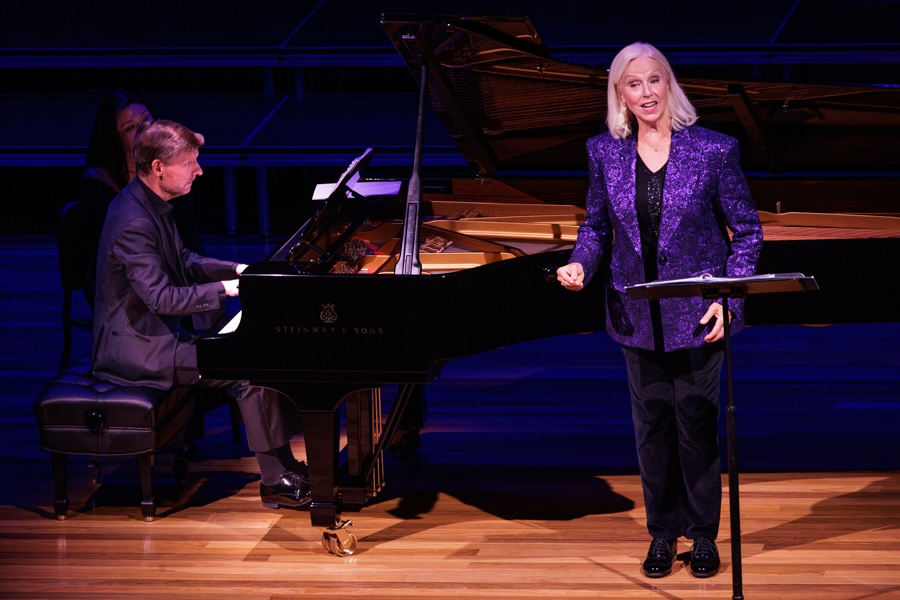
Anne Sofie von Otter and Kristian Bezuidenhout, Snow Concert Hall, Canberra. Photo © Dalice Trost
Schubert’s songs demand considerably more from the pianist that mere accompaniment: the way he demands that music and poetry work together to convey moods, emotions and stories requires a highly integrated partnership. Kristian Bezuidenhout delivered this with consistency and sensitivity to von Otter’s exacting phrasing, and he also played three short solo works (including Mozart’s Rondo in A minor and Schubert’s Hungarian Melody in B minor) to break up the song brackets.
Schubert’s Der Einsame (Solitary), was a calm and reflective way to start the concert, but also showed what superb, precise control von Otter maintains over her voice. Her expression of the words – the joy of contemplation, looking into a fire before sleep – was animated and full of raw feeling.
As is so important for a singer, the storytelling was done through the face – and especially the eyes – in a subtle, energised, unpretentious way. Never over-egged, small gestures and movements emphasised highlights in the text and changes in mood and character and switches in story-teller.
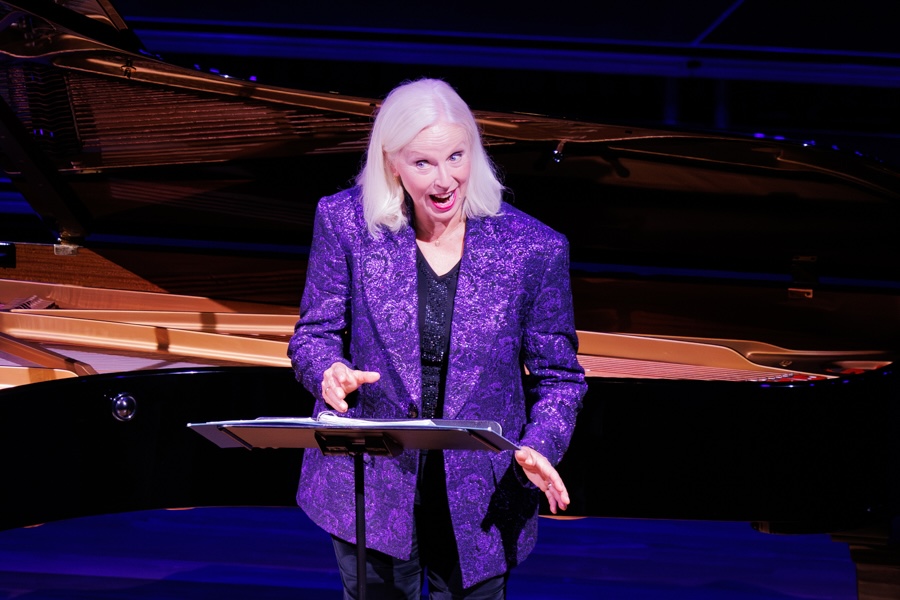
Anne Sofie von Otter, Snow Concert Hall, Canberra. Photo © Dalice Trost
Adolf Fredrik Lindblad is often referred to as Sweden’s Schubert, although he lived more than twice as long. Of his 215 published songs, von Otter chose a bracket of four to begin the concert’s second half. They fit perfectly alongside Schubert. All were sophisticated, and full of character, especially Nattviolen (Night walking), Vaggvisa (Lullaby) and the bright, optimistic En sommerdag (Summer’s day).
The program closed with seven songs from the collection of Schubert’s late works assembled by his publisher Schwanengesang (Swansong), including some of the most famous and challenging ones. Von Otter’s rendition of Ständchen (Serenade), with its changing colours and dynamics, was especially affecting, as was Der Doppelgänger – the narrator watching his own tormented figure mourning lost love.
Von Otter’s confident, anchored performance across lieder’s signature repertoire showed how an artist who looks after their instrument, and who continues to take on new artistic challenges, can continue to deliver for as long as they desire.
Anne Sofie von Otter & Kristian Bezuidenhout perform at Elder Hall, Adelaide on 25 November,







Comments
Log in to start the conversation.