

The West Australian Ballet’s tour of Dracula to Adelaide received much acclaim, although some critics were unhappy that the dancers performed to a recording, since the West Australian Symphony Orchestra had not accompanied the WAB.

After watching the opening-night performance at His Majesty’s, with the dancers back in their old hunting ground and in the presence of WASO, the criticism is understandable.

The late Wojciech Kilar was a film composer of some note (creating the score for Francis Ford Coppola’s Bram Stoker’s Dracula in 1992), and the disparate tones heard in this ballet performance, accompanied by live musicians, add so much tension to the action on stage.

Aided by Krzysztof Pastor’s fine choreography, involving both classical and contemporary dance, the dancers move, glide and hurl themselves across the stage so fast and impressively that you can almost feel the interchange of skill between dancer and musician.
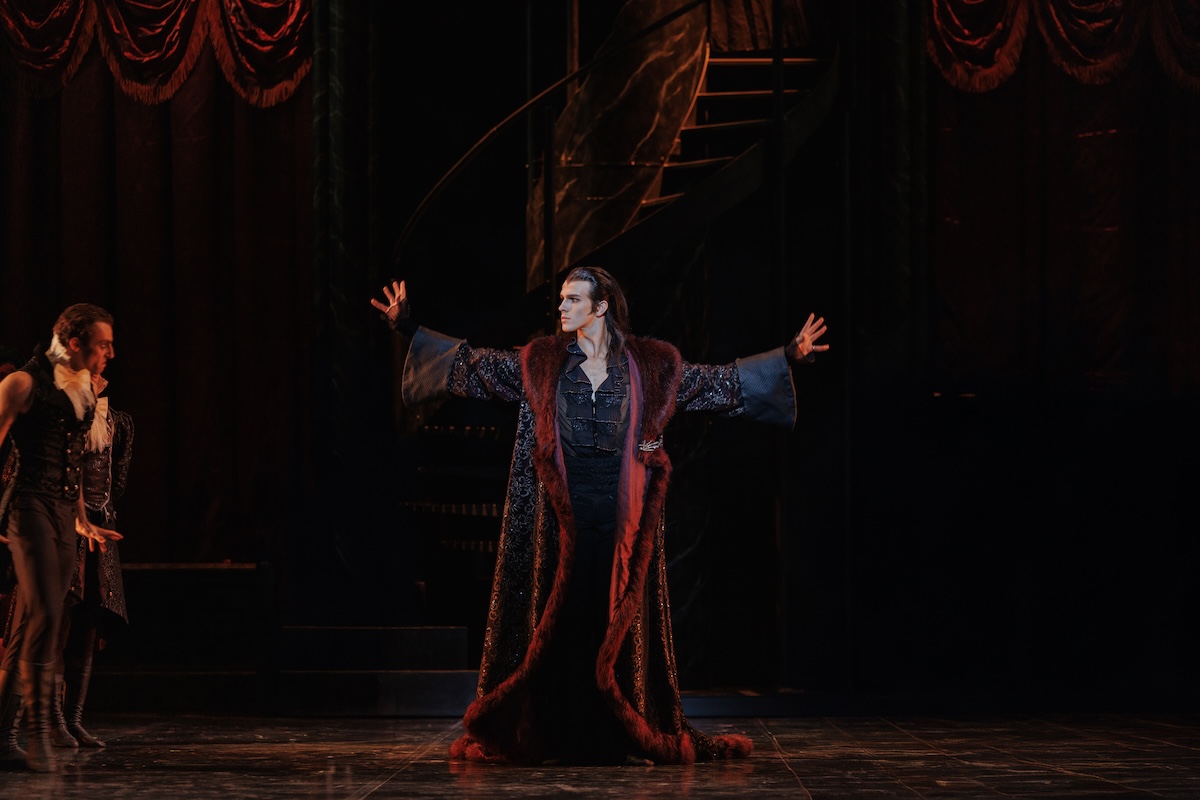
Charles Dashwood as Young Count Dracula in West Australian Ballet’s Dracula. Photo © Jonathan VDK

That this Dracula was, and has been, received with such acclaim is also understandable. It is certainly visually spectacular. With stupendous sets and gorgeous costumes designed by Phil R. Daniels and Charles Cusick Smith, beautiful lighting by Jon Buswell, Kilar’s magnificent score and the precision of WASO under the baton of Jessica Gethin, it might have seemed the dancers needed only to turn up. But without doubt they were the icing on the cake.

The action fluctuates between the lush, red-velvet, candlelit interiors of Dracula’s castle and the light, creamy comfort of the English drawing room presided over by Mrs Westenra (Indiana Scott), where Jonathan Harker (Oscar Valdes) says a fond farewell to his fiancée Mina (Nikki Blain). He is off to finalise Dracula’s purchase of a London mansion (from which, no doubt, present-day Russians got the idea).

Then there is the stark white sparseness of the lunatic asylum run by Dr Jack Seward (Juan Carlos Osma) and the vampire expert Professor Van Helsing (Gakuro Matsui). Within its confines is the patient Renfield (Jesse Homes), a lawyer earlier sent to seal Harker’s real-estate deal, who becomes a devotee of Dracula.

Things do not augur well for Harker and indeed he is set upon by Dracula’s brides – Alexa Tuzil, Polly Hilton and Kassidy Thompson – while sleeping, challenged by vampires Charles Dashwood, Adam Alzaim and Benjamin Anderson, and only evades Dracula’s teeth by the skin of his own.

Juan Carlos Osma and Charles Dashwood in West Australian Ballet’s Dracula. Photo © Jonathan VDK

Daniels and Smith explored Victorian cemeteries for the required Gothic ambience, and the exteriors of Dracula’s various abodes seem the epitome of dark, unassailable castles built of ancient grey stone slabs, statued with gorgons and pitted by the elements. Pitted and gorgon-like, moreover, is how Old Dracula (Ludovico Di Ubaldo) appears — bent and limping, with pale face, long grey hair and evil intent in search of his bloody meal. In contrast, Young Dracula (Jurgen Rahimi) appears fit, handsome, urbane and seemingly tireless – in fact, every girl’s dream lover.

And this, in essence, is where the story lies, because when Mina (who thought herself in love with Harker) meets young Dracula in London, she finds herself inexplicably drawn to him and eventually allows his teeth to sink into her soft, nubile neck, even after witnessing – once Old Dracula has savoured her blood – the torment and death of her friend Lucy Westenra (Mayume Noguromi) and the sorrow of Lucy’s lover Arthur Holmwood (Heath Kolka).

Dracula’s insatiable desire for Mina takes root because she resembles his beloved wife Elizabeth, who in the 15th century killed herself thinking her husband had died fighting the Turks. Consumed with grief and unable to give her a Christian burial, Dracula renounces God and begins his career as the quintessential vampire.

Jack Whiter,  Julio Blanes and Jurgen Rahimi in West Australian Ballet’s Dracula. Photo © Jonathan VDK

The dancers are dressed in period clothes: swirling skirts and fitted coats for the men in stylish London; white dresses for Dracula’s brides; flesh-coloured underpants and daubed naked flesh for Dracula’s Phantoms (Ruben Flynn-Kann and Joshua Ballinger); and flowing cloaks or jackets encrusted with red jewels for the two Draculas, which were flung from their bodies when they were about to drink someone’s blood.

Moments that stay in the mind often involve the artistry of Buswell’s lighting design. As the performance opened and Dracula and his adversaries fought with sabres, their long coats swirling around, you hear the clash of the blades and saw the movement through soft cones of differently coloured spotlights, two of which are set in the auditorium just off the stage. It creates a sense of the era – misty and distant.

Another memorable moment is the coffin scene, in which Dracula tucks in his vampires for the night, sliding the lids shut before a sudden flash of bright sunlight blinds and curtails him – a reminder of the vampire’s sorrowful existence.

The WAB dancers stun with their smooth high lifts, gracious extensions and formidable technical prowess; the principal artists are impeccable, and Blain and Noguromi sublime in their dramatic intensity, fine pointe work and the depth of feeling imparted during their duets with Rahimi, Valdes, Kolka, Osma and Di Ubaldo.

If you can imagine someone dancing on snowflakes, that would be the weightless Blain and Noguromi.

The WAB’s Dracula lives up to its acclaim: spectacular, beautiful and tellingly apposite for our atavistic yearning for stories in the dark.


West Australian Ballet presents Dracula at His Majesty’s Theatre, Perth until 30 May.

Contribute to Limelight and support independent arts journalism.