Grief, it turns out, makes for superb programming – provided you trust it to do the talking. This WASO concert gathered a doomed Finnish folk-hero, a Baroque widower and a symphony denying its own sorrow, and let three very different composers argue the case for suffering as the engine of great music.

Finnish conductor Kristian Sallinen made his Australian debut on the Winthrop Hall podium, and the pedigree behind him is formidable: early tutelage under Jorma Panula – teacher, in one guise or another, of most of the current generation of internationally significant Finnish conductors – followed by Sibelius Academy studies with Sakari Oramo and mentorship from Paavo Järvi and Esa-Pekka Salonen.

Finnish critics have praised the rhythmic drive and a sense of style in his conducting (Helsingin Sanomat) and noted tempos that felt like the only possible ones under his baton (Aamulehti). Perth got its first taste of both on Friday.
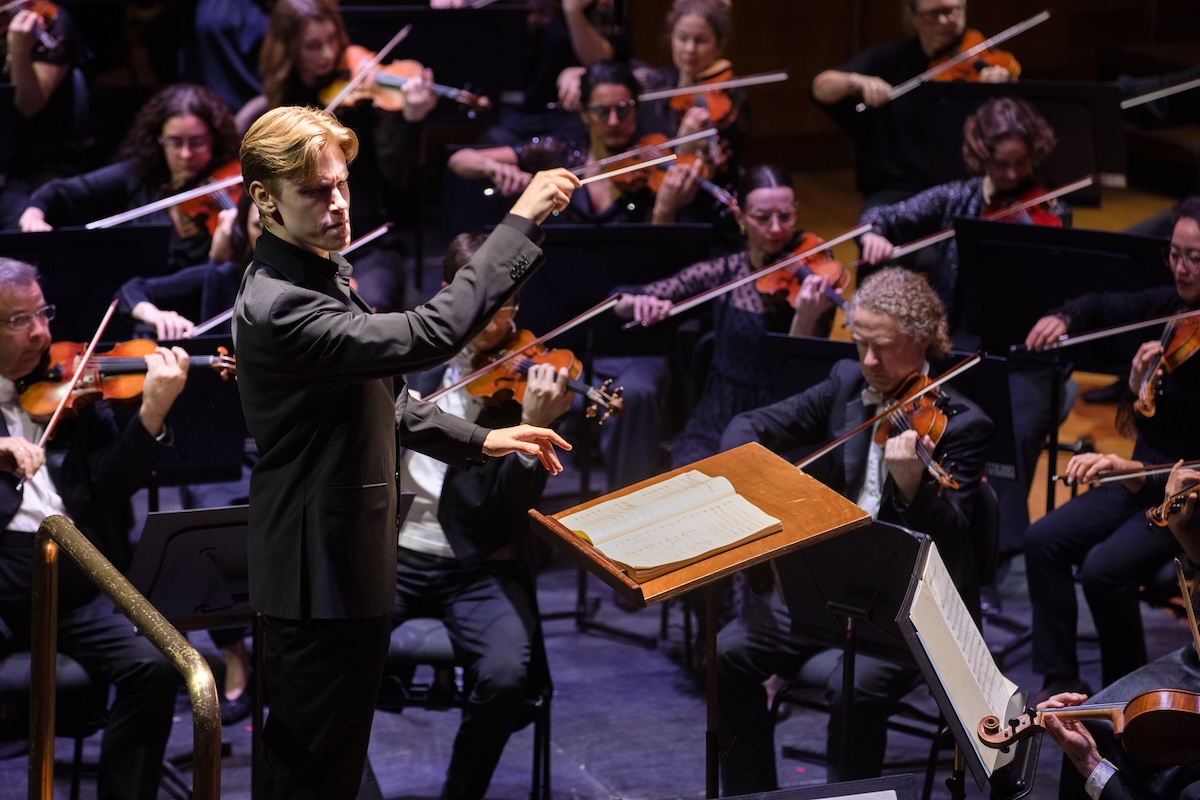
Kristian Sallinen conducts the West Australian Symphony Orchestra. Photo © Daniel James Grant

The curtain-raiser was Leevi Madetoja’s Kullervo, an 18-minute symphonic poem the 26-year-old wrote in 1913 on the same Kalevala legend that had haunted his teacher two decades earlier.

Sibelius had already composed, then suppressed, his own Kullervo Symphony in the early 1890s; Madetoja, unaware of the withdrawn score, arrived independently at a work owing less to Sibelius’s brooding modality than to the thematic development and brass-heavy climaxes of Richard Strauss, filtered through French rather than Germanic harmonic thinking – a far cry, too, from the Wagnerian weight of Kajanus’s own 1880 funeral march for the same doomed hero. It made a punchy opener and immediately revealed Sallinen as a conductor of great precision and dramatic poise, an impression the rest of the evening would only strengthen.

Tamara-Anna Cislowska and the West Australian Symphony Orchestra. Photo © Daniel James Grant

Elena Kats-Chernin’s Piano Concerto No. 3, subtitled Lebewohl, is a stranger and more ambitious proposition: a five-movement elegy for Maria Barbara Bach, the composer’s first wife, who died in 1720 during a six-week absence and was buried before Johann Sebastian returned home to find her gone.

In her program note for the work’s 2018 premiere, pianist and dedicatee Tamara-Anna Cislowska maps the five movements onto the stages of bereavement – shock, pain, anger, reflection, acceptance – each headed by a quotation from a Bach cantata of the period. She hears the opening Agitato, centred on the same D that anchors Bach’s Chaconne, as an unmarked elegy for Maria Barbara; the second movement’s C-sharp minor chorale unfolding over a passacaglia-like bass; the third turning combative, the piano’s writing broken into sevenths and ninths, its emphasis, in Cislowska’s phrase, “always slightly off centre.” The fourth movement, built from a fragile, sustained line quoting Kats-Chernin’s own piece Eggshell, gives way to a fifth that folds material from the first two movements into a brassy, ever-ascending close.

Cislowska’s own playing matched the writing’s demands: muscular and delicate by turns, the solo part virtuosic and unmistakably physical rather than spiritually transcendent – this is a concerto that inhabits the body of its grief rather than floating above it. A Bach prelude from the “48” as encore felt less a bonus than a coda: a hushed, private postscript to Maria Barbara’s memory, and a meditation on everything the concerto had just put into such physical terms.

Kristian Sallinen and the West Australian Symphony Orchestra. Photo © Daniel James Grant

Sibelius’s Second Symphony in D major is, famously, a vast fabric raised from the smallest of materials, especially that upward three-note cell in the opening bars which seems to seed almost everything that follows, gathering force across four movements until the work feels less a sequence of fragmentary episodes, more a coherent journey of self-discovery.

Sibelius pushed back against the nationalist and autobiographical meanings so readily attached to the piece, insisting instead on its status as absolute music. Yet it’s this friction between inward struggle and outward affirmation that powers the finale: the opening idea returns not as a simple reprise but as something fought for and won, having passed through the slow movement’s dark processional and the scherzo’s taut, driven restlessness – its oboe-led trio briefly exposing the human nerve beneath the mechanism – before arriving at a conclusion of unforced majesty.

WASO’s playing was sublime across every section – brass, woodwind, percussion, strings – and Sallinen’s conducting stayed authoritative, crisp and clear through all four movements, content to let the music speak for itself while never once letting the tension slacken. For a 44-minute symphony everyone in the hall already thought they knew, it was remarkably thrilling.

A 20-something Finn made his Australian debut with a national orchestra and closed out the evening as though he owned the place. WASO should have him back – and soon.

_________________________________________________________________________________

For more information on West Australian Symphony Orchestra concerts, visit waso.com.au

Contribute to Limelight and support independent arts journalism.