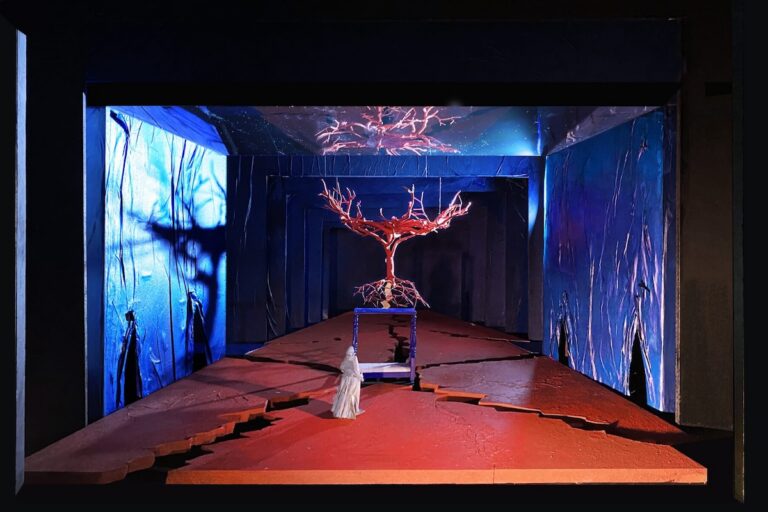
In a program note on her 2016 work The Saqqara Bird, Australian composer Melody Eötvös writes that she was inspired by theories about the bird-shaped sycamore-wood artefact excavated at Saqqara in 1898 to create a tapestry of “the mechanical, the living and the ancient becoming new again.” The result is, apparently, atypical for her: a work grounded in rhythmic and harmonic stability, with generative repetition producing a “Pinocchio-like metamorphosis.”
It made a compelling overture, The Saqqara Bird metaphorically taking flight as German conductor Anja Bihlmaier – making her WASO debut – and the orchestra caught the score’s mechanistic and organic qualities with precision and warmth.
The stage was set for American violinist Benjamin Beilman – no stranger to WASO audiences – to join Bihlmaier and the orchestra for a fine account of Mendelssohn’s Violin Concerto in E minor, Op. 64. Across its three linked movements, Beilman used a generous expressive palette with discernment. This is, after all, Mendelssohn: less combat than conversation, a quality shared with Schumann’s Cello Concerto, heard from soloist Ivan Karizna and WASO the week before.
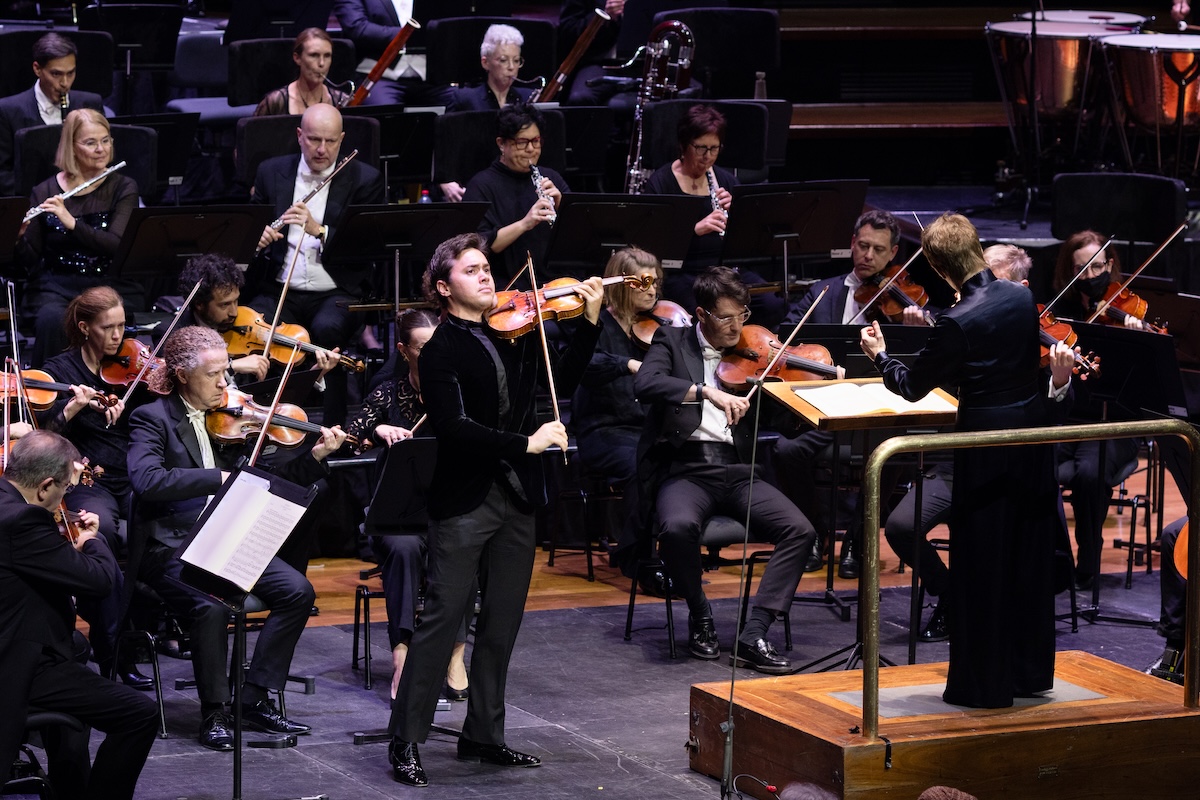
Benjamin Beilman and the West Australian Symphony Orchestra. Photo © Daniel James Grant
Beilman moved effortlessly from the opening movement’s ambiguous vocalics and marvellous cadenza through a serene C major cantabile to a sparkling, elfin finale, while Bihlmaier and WASO projected a classically proportioned sound picture enlivened by romantic burrs. Beilman’s encore – Bach’s Gavotte en rondeau from the E major Partita for solo violin – could not have been more apposite, given Mendelssohn’s love of his Baroque predecessor, or better played.
Bihlmaier’s 2024 Sydney Symphony debut was praised in this publication for having “brought the house down.” No surprise, given her accounts here not only of the Eötvös and Mendelssohn but of the extraordinary performance that followed interval.
Composed in 1937 and triumphantly premiered that year, Shostakovich’s Symphony No. 5 in D minor, Op.47 was presented by the press as “A Soviet artist’s practical creative reply to just criticism.” Shostakovich, however, preferred to describe it as tracing “the development of the individual,” lyrical throughout, with the finale resolving earlier tension “on a joyous, optimistic note.”

Anja Bihlmaier and the West Australian Symphony Orchestra. Photo © Daniel James Grant
Under Bihlmaier, the performance’s muscular clarity was clear from the first bars: canonic string entries snapped into relief, leaping sixths and narrowing thirds shaped with architectural precision. The lyrical violin line sat cleanly above, while the development’s demonic march built through pressure rather than volume. Hammered brass chords landed with Thor-like power, and the closing celesta figures remained exposed and unresolved.
The Allegretto’s waltz-grotesquerie was just as unsentimental: brass bit rather than blared, irony trumped charm, and the trio’s lyricism never warmed into sentiment.
In the brassless Largo, divided strings balanced with chamber-like transparency, the Vozrozhdenije-derived opening emerging as bare soliloquy. Mahlerian and liturgical echoes registered without indulgence, while two anguished swells were shaped with restraint, the clarity sharpening the bleakness.
The finale’s martial opening had bite, its folk-inflected passages held in firm relief, and the D minor-to-D major climax felt inevitable. In the coda, those countless quaver repetitions became a controlled, almost mechanical insistence beneath the brass’s triumph, leaving the ending suspended between coercion and jubilation.

Comments
Log in to start the conversation.