


And so we come to the end of Simone Young’s four-year Ring Cycle with the Sydney Symphony Orchestra.
At just under five hours in length, Götterdämmerung rounds out Wagner’s epic tetralogy about the consequences of defiling nature, defying the natural order of things, hubris and greed.
It’s storytelling on an epic scale, inspired by Norse mythology and a tradition that spans the dynastic dramas of Ancient Greece to modern-day mythmaking. Directors like David Pountney will point to Dune’s House Atreides, while Chen Shi-Zheng drew on Game of Thrones and Star Wars in his production for Opera Australia – Wagner’s Leitmotifs certainly provided the blueprint for John Williams’ motivic soundtrack to George Lucas’s space opera.
Yes, the Ring is a beast, and it takes a conductor of immense artistry, stamina and, given the high stakes, even tenacity to tame it. Simone Young is that conductor, and her reading of Götterdämmerung proves it.

Simone Young conducts Götterdämmerung with Eleanor Lyons, Margaret Plummer and Catherine Carby and the Sydney Symphony Orchestra. Photo © Daniel Boud
Among the many challenges that the Ring presents is the need to maintain dramatic continuity across the four operas, and to respect Wagner’s sprawling musical architecture. This requires the conductor to trace the nuanced development of its Leitmotifs over 15 hours of music.
It’s hard enough when the Ring is staged in a single week, but performed over four years, it becomes a Herculean task to trigger the audience’s power of recall, especially given the mutability of the themes which Wagner uses to convey subtext.
Here Young excels in ways that transcend the laws of time, and as Götterdämmerung unfolds, we reap the dividends of the dramatic choices she first made four years ago in Das Rheingold, and subsequently in Die Walküre and Siegfried.
It’s as if these concerts only took place earlier this week, and it’s even more remarkable given the fact that we’ve had multiple cast changes throughout the Cycle, with two Alberichs (Falk Struckmann, who returns here as Hagen, and Warwick Fyfe) as well as two Brünnhildes (Anja Kampe and Miina-Liisa Värelä) and two Siegfrieds (Simon O’Neill and Klaus Florian Vogt).
Kampe returns as Brünnhilde, allowing us to appreciate the former Valkyrie’s struggle to come to terms with her newfound mortality and betrayal by the drugged Siegfried (Vogt).
And while much of the success of this Ring Cycle is owed to its uniformly impeccable company of singers, it’s what normally happens in the pit that really makes the difference.
Simone Young conducts Götterdämmerung with Anja Kampe and the Sydney Symphony Orchestra. Photo © Daniel Boud
Here, for all to see is Wagner’s genius, expertly rendered by the onstage musicians of the SSO. It would be easy to wax lyrical about this being the best rendition of Siegfried’s Funeral March I’ve ever heard – and I’ve heard a lot. I could echo that sentiment about Brünnhilde’s Immolation Scene.
But it’s the way Young and the SSO elevate Wagner’s own unique approach to word-painting that really sets this extraordinary concert apart.
A prime example is Act 1, Scene 3, in which Brünnhilde’s sister, the Valkyrie Waltraute (Deborah Humble), arrives at her sister’s craggy outpost and begs her to return the ring to the Rhinemaidens so they can free it from Alberich’s curse.
The efficacy with which Young and the SSO depict Waltraute’s galloping steed is awe-inspiring, as is their rendering of the magic fire around Brünnhilde’s rock with its woodwind trills and shimmering strings.
Then, as Waltraute recounts what has happened at Valhalla, the percussive chopping and stacking of wood from the World Ash Tree is sharply contrasted with the hushed silence of its hallowed halls, perfectly evoked by tremulous strings and dark woodwinds.
This is word-painting of the highest order, and as Wagner’s notes fill the Concert Hall, they conjure a vivid image of the gods assembled in rows around Wotan – Waltraute’s account of his splintered spear punctuated by a now-anguished variation on the ‘spear’ motif.
Simone Young conducts Götterdämmerung with Deborah Humble and the Sydney Symphony Orchestra. Photo © Daniel Boud
However, Wagner does so much more than traditional word-painting, employing Leitmotifs to not only reveal hidden memories and psychological meaning, but also dramatic irony.
When Brünnhilde refuses to return the ring, Wagner reuses the ‘Renunciation of Love’ motif from Das Rheingold. The irony is striking: Brünnhilde cannot relinquish the ring because it is the token of Siegfried’s love, yet the music recalls the very renunciation of love that set the cycle’s tragedy in motion.
The fact that it immediately resonates, four years after it was first heard in this Cycle by the SSO, is a testament to Young’s profound ability to tie together Wagner’s musical and narrative threads with such clarity.
As in previous years, Young’s deft use of spatialisation creates an immersive environment, with horn calls coming at us from all directions.
And despite the work’s mythic nature, the cast manage to make their archetypal characters relatable, thanks in no small part to director Caroline Staunton.
Yes, Siegfried will always be the impulsive manchild, but even as he lands in one bind after another, Vogt manages to make his naivety a little more endearing than usual.
As Brünnhilde and Gutrune, Kampe and Eleanor Lyons are contemporary women, their responses to the injustices they face ranging from genuine bemusement to downright disgust and fury.
Simone Young conducts Götterdämmerung with Falk Struckmann and the Sydney Symphony Orchestra. Photo © Daniel Boud
Much to our delight, Fyfe wallows in the grotesquerie of Alberich, and Struckmann is equally malevolent as his son Hagen.
As Gunther, Samuel Dundas is a genuinely reluctant accomplice to his half-brother Hagen’s plot to kill Siegfried, and Deborah Humble is utterly compelling as Waltraute.
As the three Norns, Catherine Carby, Margaret Plummer and Lyons achieve the impossible and make what is often a stodgy half-hour prologue fly by. For the first time in my life, I am sorry to see them go.
Fortunately, Carby and Plummer return alongside Samantha Clarke as the delightful Rhinemaidens, their effervescent voices combining in lush three-part harmony.
Across the tetralogy’s 15 hours, the chorus sings for only 10 minutes, and the Sydney Philharmonia Choirs under Elizabeth Scott make the most of their brief contributions as the Gibichung vassals, adding vital colour to the wedding and hunting scenes.
Like the orchestra, the singers and choir all give exemplary Wagnerian performances, but special mention has to go to Kampe, whose radiant voice and tireless navigation of her role’s extreme vocal and emotional ranges places her in the pantheon of the greatest Brünnhildes.
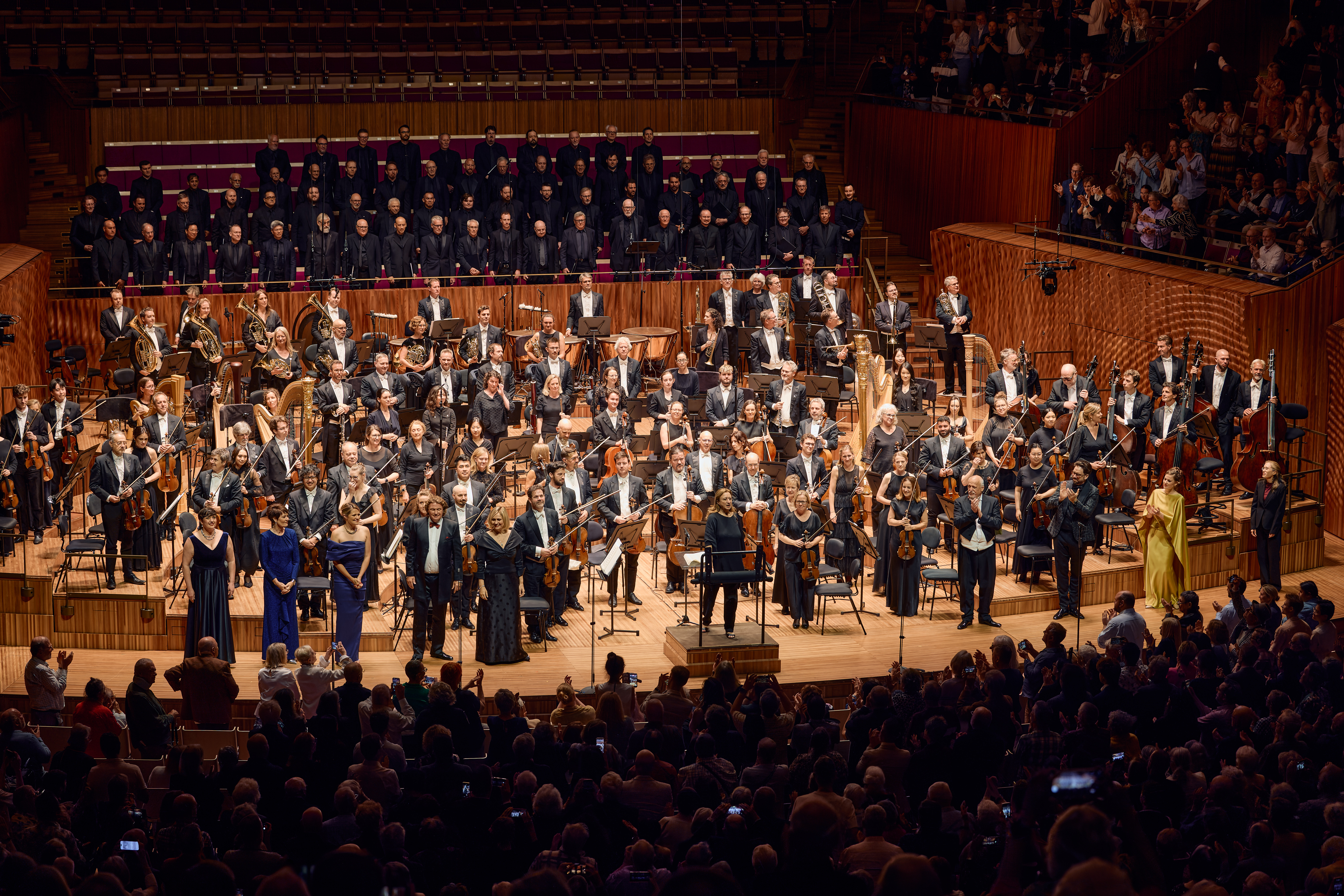
Simone Young conducts Götterdämmerung with the Sydney Symphony Orchestra. Photo © Daniel Boud
Not surprisingly, these extraordinary singers and musicians are rewarded by a tumultuous and well-deserved standing ovation. However, as the cheers die down, a sense of melancholy sets in.
Yes, we’ve just heard the world end, but more than that, it’s the realisation that this four-year journey with Young and the SSO is over. It’s been a music-making miracle, and one that will be hard to beat.
As we file out of the auditorium, the lady next to me says, “I think I’ll see it again on Sunday.”
I’m tempted to do the same.
Sydney Symphony Orchestra presents Götterdämmerung at the Sydney Opera House at 2pm on Sunday 22 November.







Comments
Log in to start the conversation.