




Lucas and Arthur Jussen have been causing a stir on their New Zealand and Australian tour. They’re young, fiery, and their lighthearted sibling energy invigorates the variety of repertoire they’ve brought with them, including Francis Poulenc’s playful and lesser-heard Concerto for Two Pianos.
The concerto was paired with Ottorino Respighi’s The Pines of Rome for the Sydney Symphony Orchestra’s Symphony Hour series. These concerts are always short, sharp and sweet, but perfectly fitting for the intense narrative of the repertoire on offer.
Under the baton of conductor Stéphane Denève, I was prepared for a performance that would lean into Poulenc’s comedic side – the rushing mania of the concerto’s fast-paced opening, the mosaic of fleeting ideas that constantly propel it forward.
However, while Lucas and Arthur were nothing short of charismatic, and their playing embodied the concerto’s witty frivolity, it was in the moments of Poulenc’s deep sentimentality that their mature sense of musicality truly shone. The lulling second movement was a haze of understated beauty – a tiptoe between Mozart-inspired elegance and Poulenc-inflected curiosity, handled with impressive delicacy.
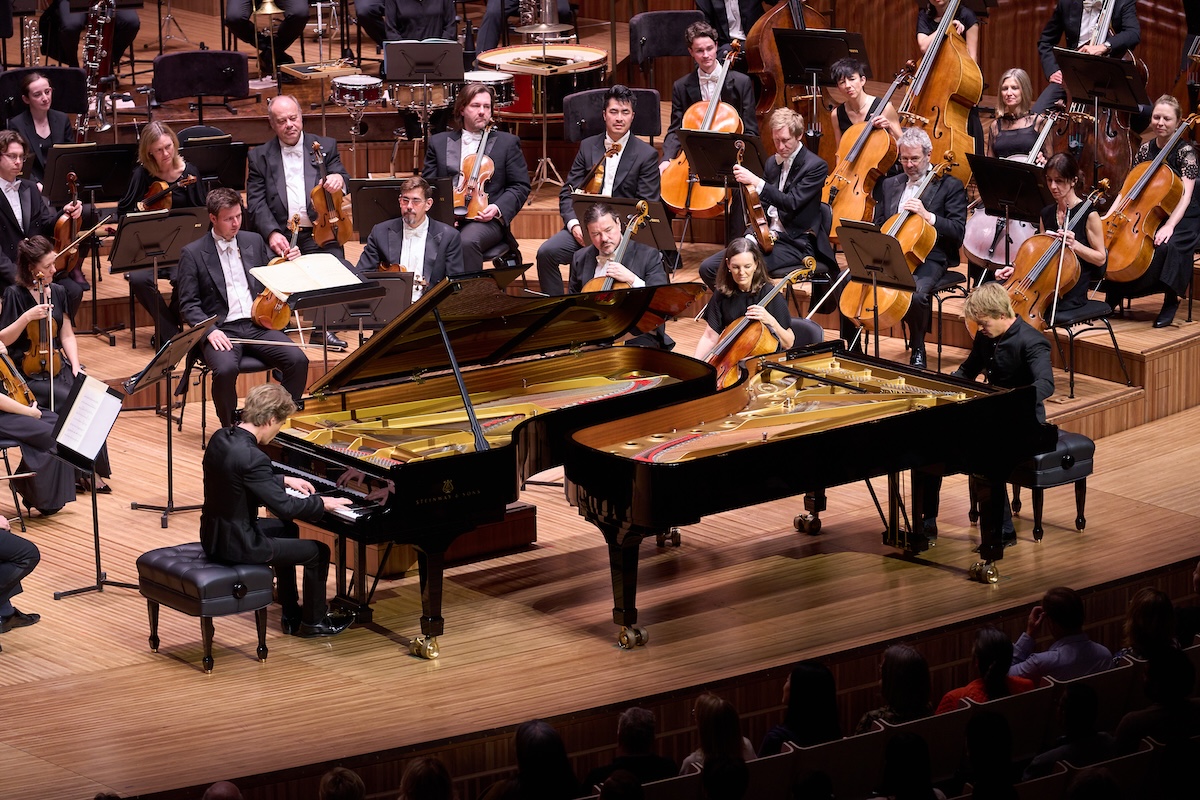
Lucas Jussen, Arthur Jussen and the Sydney Symphony Orchestra. Photo © Jay Patel
These moments of quietude drew the audience into the brothers’ orbit, revealing their incredible capacity to fill the expanse of the concert hall with the gentlest touch of sound. This subtlety echoed through their approach to ensemble: the brothers shared as much unspoken communication between themselves as they did with Denève and the individual players of the orchestra.
Then came the rapid finale: the brothers injected their interpretation with sparkling spontaneity. Everything about their approach felt organic, to the point where it was not just the audience on its toes, but at times the Sydney Symphony too.
After resounding applause, the encore was a sneak-peek premiere. With a cheeky swap of pianos, Arthur and Lucas presented Igor Roma’s arrangement of the waltz from Dmitri Shostakovich’s Jazz Suite No. 2. Embellished with dizzying chromaticism, the brothers became an orchestra unto themselves, conjuring a captivating array of colour from just two pianos.
The stage was then rearranged, and, as this concert was without an interval, Denève used this time to address the audience, providing an introduction to the final work of the program, Respighi’s The Pines of Rome. This four-movement tone poem voyages through both Rome’s landmarks and its epochs. In Denève’s words, it is ‘music like a perfume’: fragrant, poetic and refined.
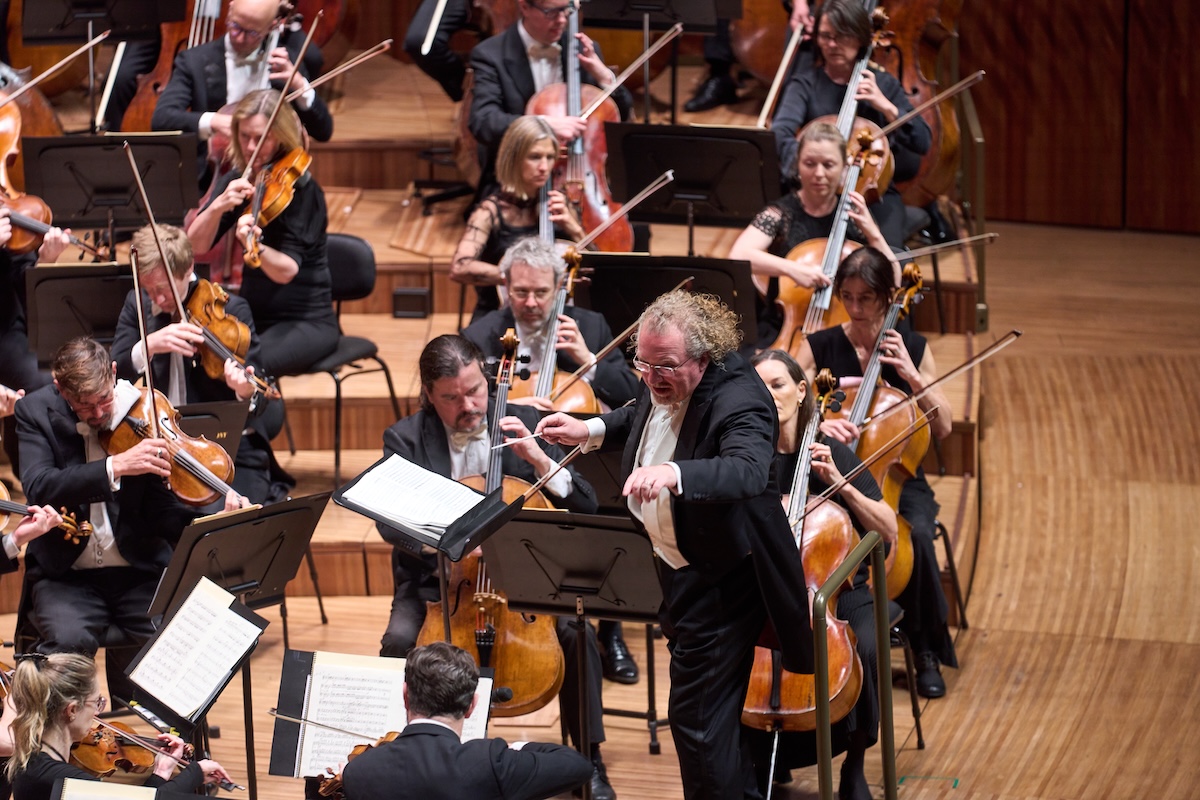
Stéphane Denève and the Sydney Symphony Orchestra. Photo © Jay Patel
His interpretation certainly lived up to this evocation, with a particularly nuanced control of the shades of light and dark that flit back and forth across the work.
The Pines of Rome is laden with instrumental solos, but David Elton’s lyrical off-stage trumpet melody was a particularly stirring highlight – distantly longing and yet full of a sonorous warmth that made it feel as if it were sounding from the centre of the stage. The opening clarinet solo of the third movement, in which the soloist is instructed to play ‘as if in a dream’, was also performed sensitively by Francesco Celata.
This set the mood for the third movement’s feature: the inclusion of a recording of nightingale song. In a tribute to the technology of Respighi’s time, an on-stage gramophone projected the recording. Denève’s attentiveness to this small detail was a delightful touch, and in the final movement, he enhanced the spatial aspect of the oncoming armies by placing the off-stage brass up in the concert hall boxes, to the head-turning fascination of the audience. This fanfare led to the work’s final climax, a thrilling force of sound and a spectacular close to what was an engaging hour of music.
Lucas & Arthur Jussen Perform Poulenc with Melbourne Symphony Orchestra on 10-12 September.








Comments
Log in to start the conversation.