


The attractive tonal music of Ella Macens, with its rich string sound and deft handling of orchestral textures and colours, makes her one of the most popular of the current generation of Australian composers.
Her music is steeped in the choral traditions of her Latvian ancestry and this, combined with her frequent use of folk-based themes and gorgeous, serene crescendos reminiscent of the likes of Pēteris Vasks, keeps the 35-year-old busy with commissions from both Australian and international ensembles.
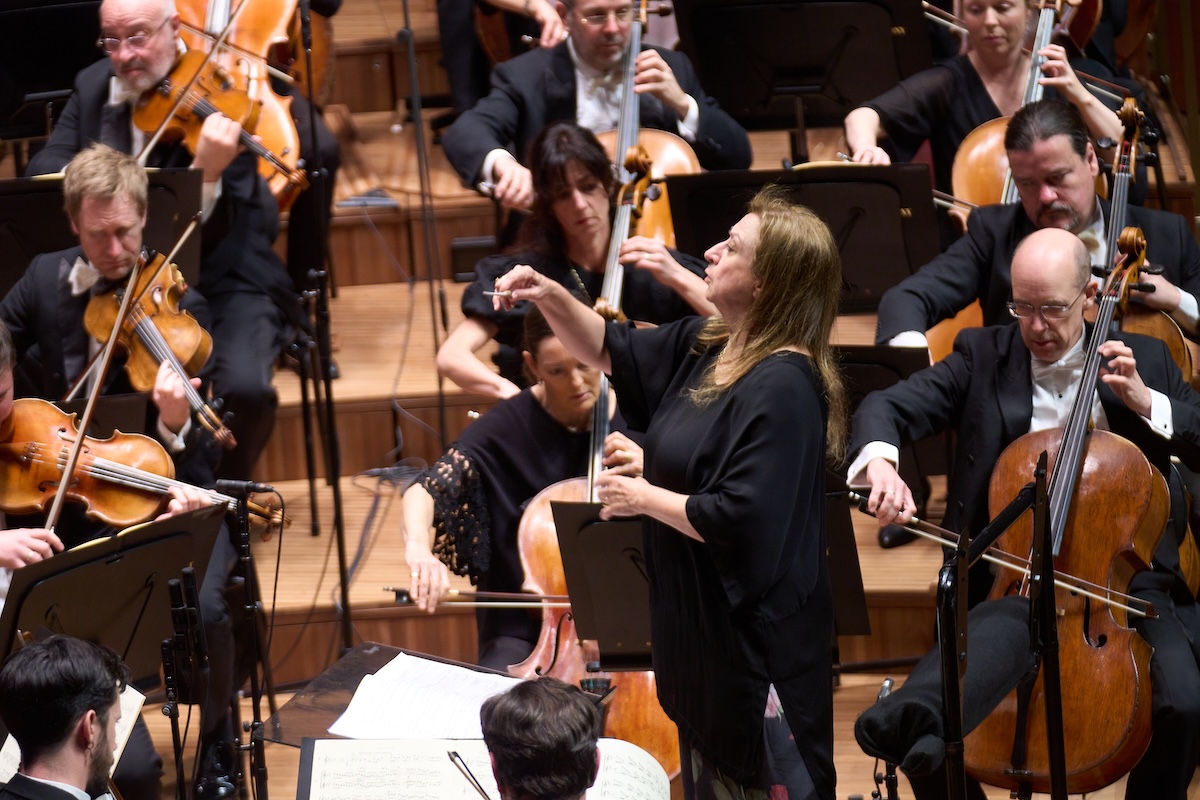
Simone Young and the Sydney Symphony Orchestra. Photo © Jay Patel
Sydney Symphony Chief Conductor Simone Young wanted a new work from her to accompany JS Bach’s Suite No. 3 and WA Mozart’s Symphony No. 39 on her latest tour, and Macens created Before Me, There Was You, a 13-minute tribute to her mother, Viktorija, who was turning 70 at the time of its world premiere.
“For a brief period, I will be exactly half her age; an alignment that occurs only once in our lifetime. This became a lens through which I reflected on continuity, lineage and the passage of time,” she says.
Using the pared-back forces of Bach’s Baroque orchestra, Macens sets up a gentle, pulsing, repeated motif in the strings and Nathan Cox’s harpsichord, layering solos from Shefali Pryor’s oboe, Richard Waters’ viola, Concertmaster Andrew Haveron’s violin – in tandem with Harry Bennetts at times – and new Principal Cello Jesper Svedberg, swelling to a cinematic climax beneath the velvety harmonies of three trumpets led by Brent Grapes.
The result is an intimate work, graceful, affectionate and moving, which Macens describes as “the bittersweet intersection of gratitude and grief”. One could sense the connection felt by the packed audience.
Young sat at the harpsichord to direct a bracing performance of Bach’s suite, infused with majestic energy and colour from the trumpets and strings in the opening Overture and the dance movements, beautifully contrasted in the famous Air, with Haveron leading the elegant, hushed strings over the great strolling bass line.
Young brought a sense of assured balance to Mozart’s great E-flat symphony, which is often overshadowed, unjustifiably perhaps, by the 40th and Jupiter, which were also written in 1788, three years before his death.
The SSO’s charismatic Principal Clarinet Olli Leppäniemi was prominent with his solo in the Trio of the third movement, and Young ensured that the jubilant Finale maintained its effervescence and momentum.







Comments
Log in to start the conversation.