




Mahler’s Ninth doesn’t so much end as stop breathing. The last page of the Adagio is marked ersterbend – dying away – and in a great performance you can’t say exactly when the music becomes silence. On Friday night Winthrop Hall held that silence for what felt like an eternity. Nobody wanted to be the first to break it.

Asher Fisch and the West Australian Symphony Orchestra, Winthrop Hall, Perth. Photo © Daniel James Grant
Asher Fisch’s Mahler with WASO has been one of the great Perth stories of the past decade, including a Second of near-miraculous architecture, a Third of sensuous ferocity and an Eighth that steered its massed forces between restraint and chaos. Mahler’s Symphony No.9 in D major asks for something else. Completed in 1910 and first performed by Bruno Walter in Vienna a year after the composer’s death, it is less a wall of sound than chamber music for orchestra. Under Fisch’s baton, 80-odd minutes became one long exhalation.
Winthrop Hall’s generous acoustic could easily have blurred the opening. It didn’t. The halting, syncopated figure in cellos and horn (David Evans), the harp tolling beneath, the second violins’ sighing two-note descent: each was etched rather than smudged. Alban Berg heard in this Andante comodo “an unheard-of love for this earth”, and Fisch let that love build in great waves, each collapse more brutal than the last.
At the climax marked Mit höchster Gewalt, trombones and timpani hammered out the faltering rhythm like a sentence being passed. Then the coda’s slow disintegration, flute (Andrew Nicholson) and Evans’ horn trading fragments over almost nothing, concertmaster Riley Skevington spinning a thread so fine it seemed to hang in the hall’s upper air.
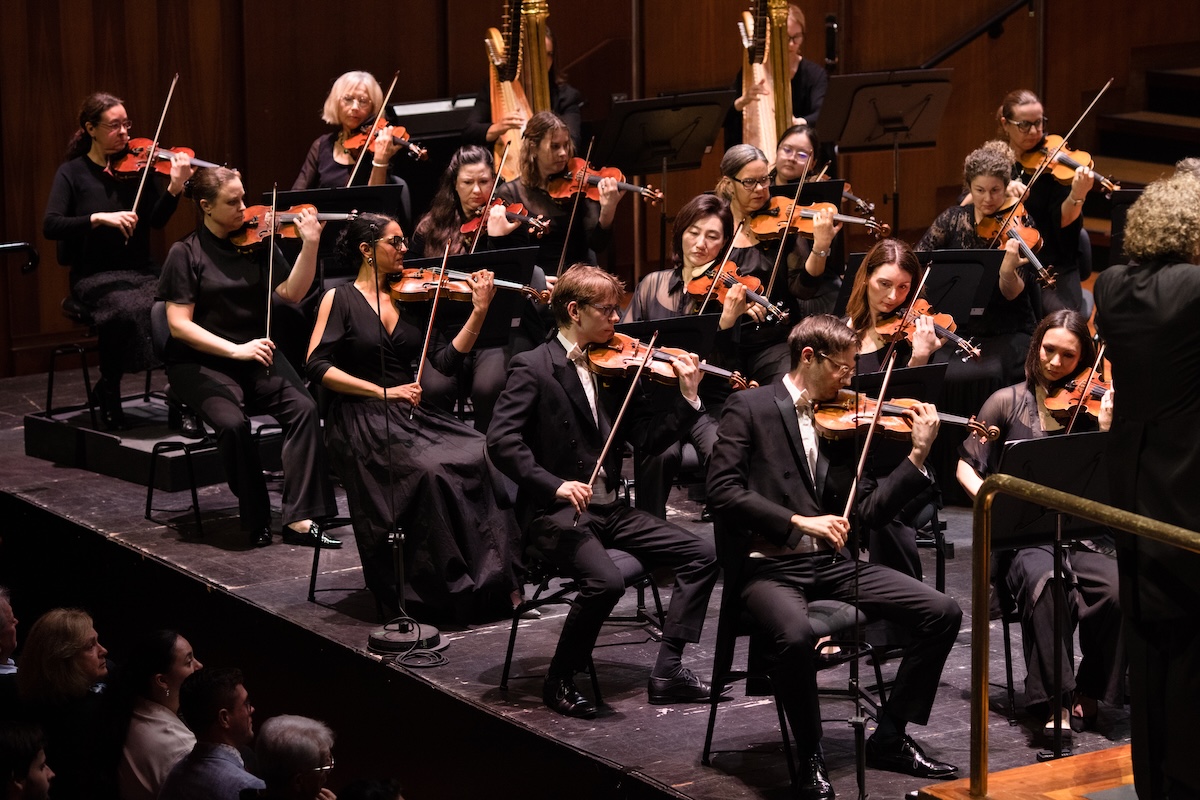
Asher Fisch and the West Australian Symphony Orchestra, Winthrop Hall, Perth. Photo © Daniel James Grant
The second movement’s Ländler is marked täppisch und sehr derb – clumsy and very coarse – and bassoons and violas took Mahler at his word. Fisch kept the three dances sharply distinct: the lumbering Ländler, the brash, almost vulgar waltz, the slow Ländler glancing back at a Vienna already gone. The Rondo-Burleske, marked sehr trotzig, bristled with acid counterpoint. Here the hall worked against the orchestra, the frenetic final stretta threatening to congeal into a roar. But the central episode, where the trumpet (Jenna Smith) first sounds the turn figure that will become the Adagio’s main theme, glowed like a glimpse of another symphony entirely.
And then the Adagio. WASO’s strings, so often the orchestra’s glory under Fisch, poured out the opening hymn with a burnished, almost Brucknerian weight, while the contrabassoon (Chloe Turner) growling beneath the high violins opened an abyss in the middle of the texture. Fisch never let the climaxes tip into histrionics. He was saving himself for what came after.

Asher Fisch and the West Australian Symphony Orchestra, Winthrop Hall, Perth. Photo © Daniel James Grant
The final pages are a quotation and a vanishing. The quotation is from the fourth of the Kindertotenlieder – “the day is fine on those heights” – and the vanishing is everything that follows. Mahler marks the last bars Adagissimo, and Fisch took him at his word. Lines thinned to single threads. Dynamics dropped below anything I’d have thought this orchestra, or this hall, could sustain. The violas carried the last fragment of the turn into near-inaudibility. It was like late Turner, where the ship and the harbour dissolve into the light that was meant to show them, and the light is all that is left.
Fisch has given Perth plenty of Mahlerian noise and glory over the years. It took the quietest bars he has yet conducted here to show how far he and this orchestra have travelled together.







Comments
Log in to start the conversation.