


Three minutes, a brass section and a battery of percussion. Aaron Copland needed nothing more for Fanfare for the Common Man, and in the spacious acoustic of UWA’s Winthrop Hall WASO’s brass and percussion rang out nobly.
Timpani and bass drum strike. A lone trumpet answers. The rest of the brass gather round it in open fourths. Copland’s 1942 wartime commission is as concise as a Roman monumental inscription, each letter cut deep enough to be read from the far end of the forum.
It made an arresting opener, and an object lesson in how little a composer needs for maximum dramatic effect.
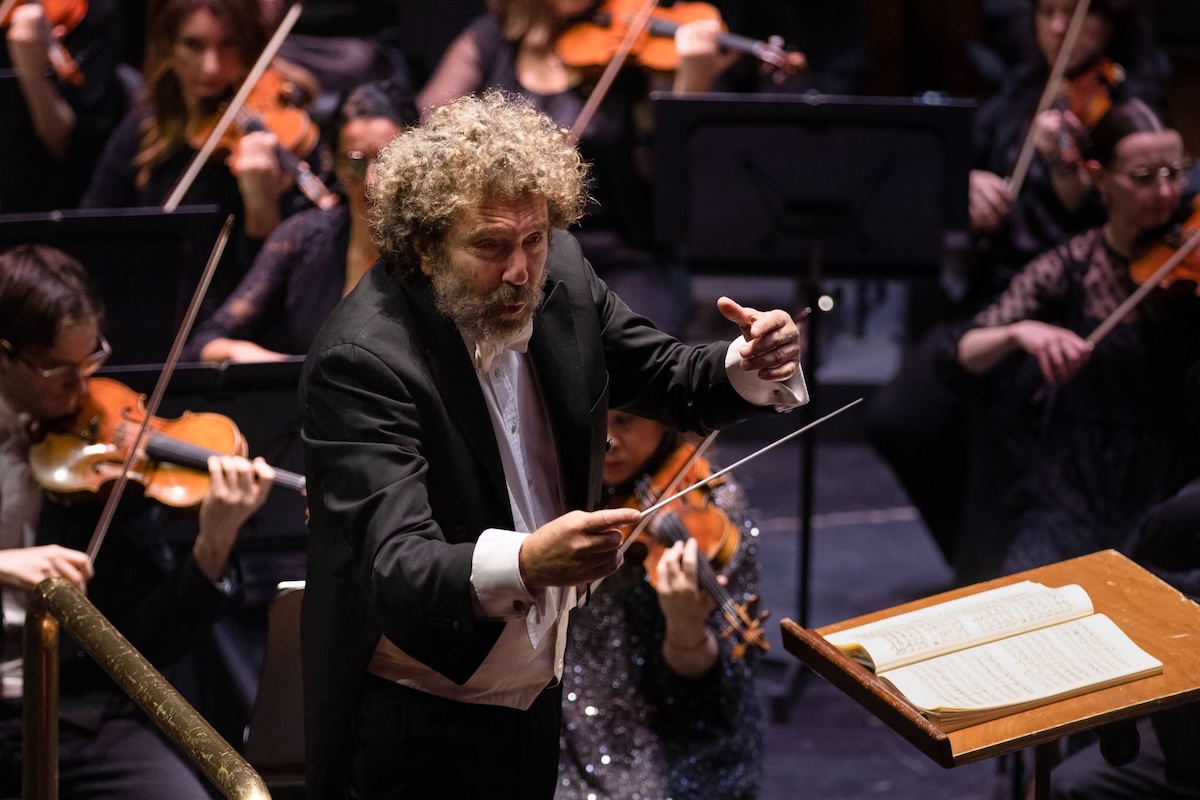
Asher Fisch conducts the West Australian Symphony Orchestra’s Rachmaninov Second Symphony. Photo © Daniel James Grant
Australian composer James Ledger’s Clarinet Concerto, commissioned for WASO by Geoff Stearn and here receiving its world premiere, works from the other end. In his program note Ledger says his music has for some time been “moving away from pitch and harmonic centred music towards colour and gesture”. He found in the clarinet, with its “astonishing array of extended techniques”, the ideal vehicle.
The five movements share and rework their material. In the opening Quasi una fantasia the soloist is shadowed by orchestral clarinets placed far left and right, in what Ledger calls “a dark canonic shimmer”. Scala’s lattice of rising and falling lines recalls, in the composer’s words, “the impossible staircases of M.C. Escher”.
Recitative is an “inner monologue” moving between “anguished multiphonics and lyrical simplicity”. The Cadenza takes the instrument to its edges. Con slancio drives towards a final “light-filled spectral multiphonic”, left hanging until a single bass-drum stroke cuts it dead.
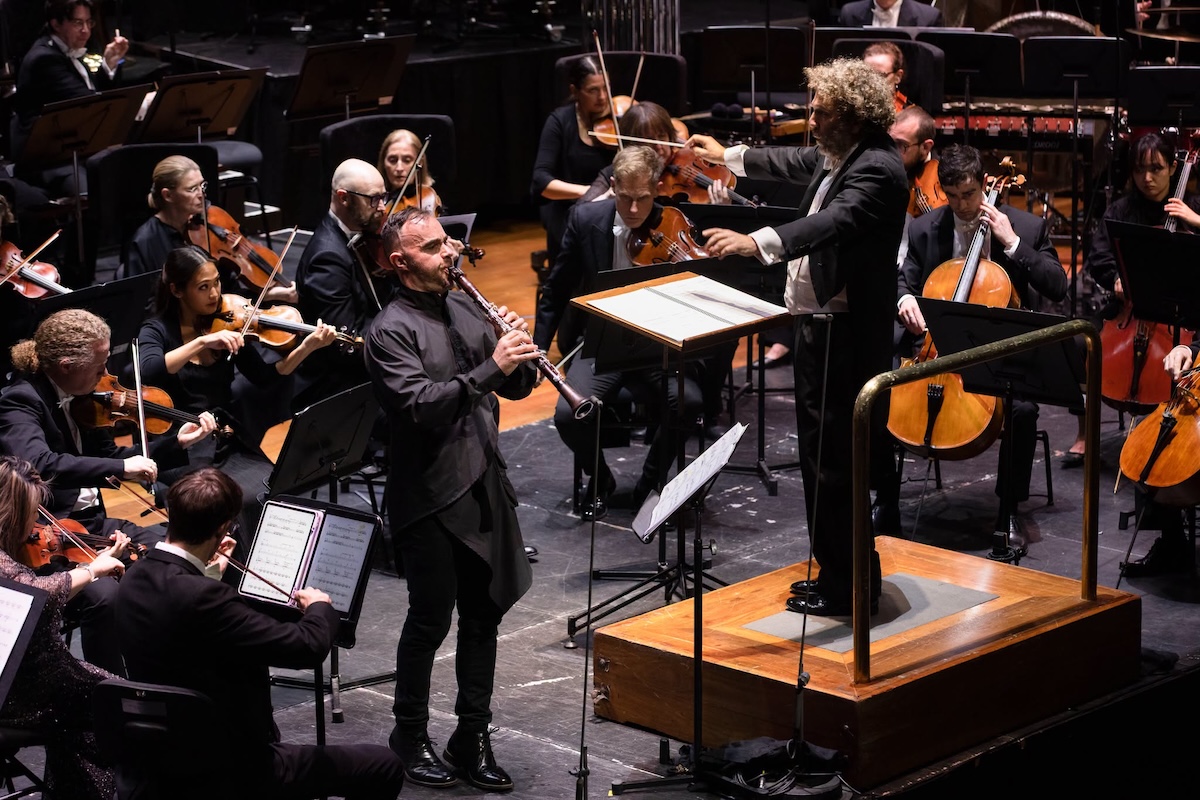
Ashley Smith, Asher Fisch and the West Australian Symphony Orchestra. Photo © Daniel James Grant
Ashley Smith, for whom the concerto was written and who worked with Ledger on the score, dazzled. His command of the instrument is protean: from Scala’s “impossibly fast arpeggios” to the bends and screams of the Cadenza, nothing sounded like effect for its own sake.
WASO knows Ledger’s idiom well by now and met the music with a genuine sense fluency, but also discovery. Asher Fisch, at once meticulous and flexible, extracted every ounce of colour, texture and, yes, excitement from this richly expressive new concerto.
Fisch brought those qualities, and much more besides, to Rachmaninov’s Second Symphony. Composed in Dresden in 1906-07, a decade after the debacle of the First Symphony’s premiere, it was for years routinely cut, which distorted its proportions.
Those proportions are the point. A brooding motto in the low strings seeds the whole work. The Dies irae lurks beneath the scherzo’s brilliance. The Adagio spins out one long-breathed melody after another, and the finale turns E minor’s unease into E major affirmation. After Ledger’s multiphonics, the Adagio’s famous clarinet melody – and here, Allan Meyer excelled – sounded like the same instrument remembering how to sing.
A superlative performance, the equal of anything Fisch has given us in his Mahler.






Comments
Log in to start the conversation.