Dmitri Shostakovich’s Concerto for Cello No. 1 in E flat, Op. 107, written in 1959 for the then youthful prodigy Mstislav Rostropovich, is one of the most eloquent of the composer’s works in voicing the anguish he must have felt in Stalin’s Russia, even though it was written six years after the great leader’s death.

Visiting Belarussian-born, French cellist Ivan Karizna’s performance fully conveyed the complex emotional states that can be interpreted from Shostakovich’s score. Tall, 34-year-old Karizna is an imposing but humble figure on stage and while his sound can be big and imposing, it can be sublimely subtle and delicate.
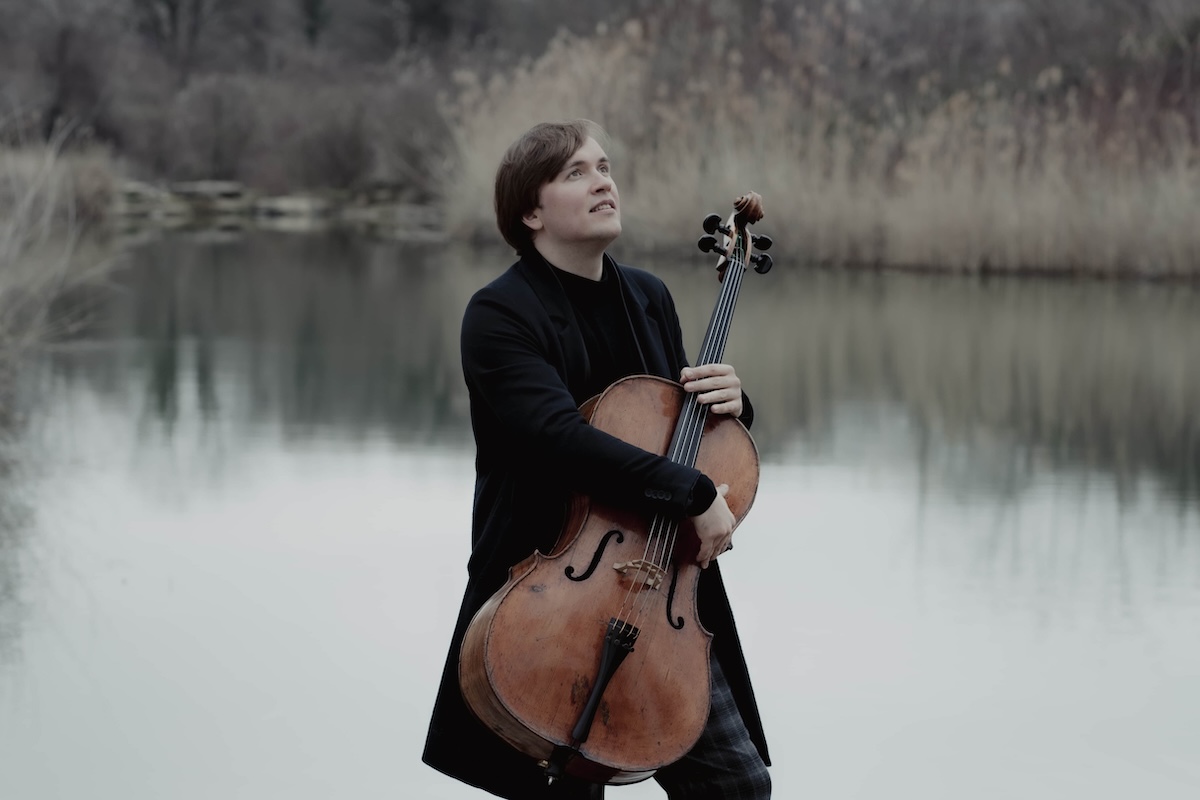
Ivan Karizna. Portrait © Lyodoh Kaneko

At first, the opening Allegretto movement seems light and jocular, but it becomes clear that the cello, representing the composer, is haunted and perhaps hunted still. The cello, winds and horn seem to be engaged in a strange dance.

The second Moderato movement opens with a horn announcement introducing a despairing cello theme. Slow and deeply melancholy, the long cello solo is exquisitely delivered by Karizna before an orchestral climax and the return of the horn. A passage of almost inaudible cello harmonics accompanied by a gently tinkling celesta evokes the composer’s private tears, and the movement ends exhausted, with soft timpani.

As if this was not evocative enough, Shostakovich’s cadenza occupies its own six-minute movement. It’s like a desolate diary entry that recalls earlier themes, returning like memories or recurring nightmares.

Continuing attacca from the second movement, the soloist begins slowly and hesitantly, with thoughtful rests. Double stopping creates two themes momentarily, as if the writer is struggling to settle on a position or belief. Karizna is outstanding in one of the most angst-ridden and technically demanding cadenzas in all music.

The short, frantic Allegro final movement again proceeds attacca, as if the protagonist is suddenly jolted from his unhappy reverie, and the drama of the first movement returns. Rapid cello passages require the utmost skill of the soloist, and the movement ends abruptly.

The enthusiastic audience demanded an encore and Karizna obliged with a powerful performance of Giovanni Sollima’s Lamentatio, which requires the performer to sing while playing and which continued the mood of the Shostakovich.

The theme of this concert was ‘nature untamed’ and the other works on the program all characterised the theme in various ways.

The evening opened with Benjamin Britten’s 1941 arrangement of the second movement of Gustav Mahler’s third symphony of 1895. Entitled What the Wild Flowers Tell Me, this arrangement is set for a somewhat smaller orchestra than Mahler’s. It’s a delight on its own and it worked well to launch this wildly contrasting concert program.

Jakub Jankowski

Jakub Jankowski. Photo © Sebastian Collen

Mahler set the piece for a moderate minuet tempo, and it begins slowly, with a dreamy oboe line, with the woodwinds creating the colours representing the diverse flora nodding in the breeze on a sunny afternoon.

To characterise the sounds of nature in a very different way, Adelaide composer Jakub Jankowski’s delightful Courante requires the use of a wide range of sound-making objects, some of which might not be associated with music of any kind.

Commissioned by the ASO, Jankowski’s marvellously imaginative eleven-minute work requires violinists to use the toothed, wooden guiro bow or comb bow on the violin’s strings and on the tailpiece to produce the croaking sound of frogs. Dried eucalyptus branches are waved to make a rustling sound and, amongst other objects, a nightingale whistle, a wind machine and even the whirr of an electric drill can be heard.

Jankowski adroitly combines all of these with conventional instruments to create the kind of sound world that might accompany a David Attenborough documentary, and given the dance reference of its title, Courante evokes the gently flowing dance of nature. In the absence of thematic or melodic development, it resembles sonically complex ambient drone, mostly very quiet, and sometimes barely audible. The eucalyptus branches carry symbolic power visually, but audience members should close their eyes and allow their imaginations to wander.

The concert concluded with Antonin Dvořák’s Symphony No. 8 in G, Op. 88 of 1889, an uplifting and joyous work written to celebrate the composer’s election to the Bohemian Academy. It opens with a regally solemn theme, perhaps acknowledging emperor Franz-Joseph of the Austria-Hungarian empire of which the composer’s native Bohemia was a part, before bird calls in the flutes herald a glorious main theme.

The symphony has a pastoral feel, and the second Adagio movement suggests Dvořák’s passion for his home countryside. Stormy moments pass quickly and bird calls continue to punctuate the music.

The bright, cheerful Allegretto grazioso third movement opens with a Viennese waltz, then shifts to a Bohemian dance and finally returns to the Viennese waltz – the Viennese waltz acknowledges the imperial capital, and the Bohemian dance asserts Dvořák’s native culture. The regal fanfare returns in the final movement and there is a triumphant coda to conclude.


Adelaide Symphony Orchestra performs Nature Untamed on 6 June, Adelaide Town Hall.

Contribute to Limelight and support independent arts journalism.