


Artistic Director and founder of the BAA Madeleine Easton directs a festive ensemble of five solo singers, the 11-strong Choir of St James’ King Street, Sydney, and the 21 specialists of the Bach Akademie Australia Orchestra under Concertmaster Julia Fredersdorff.
Playing on period instruments, they present Marc-Antoine Charpentier’s Messe de minuit pour Noël H 9 (c. 1694) and two Advent cantatas by J S Bach, Nun komm, der Heiden Heiland (BWV 62) and Wachet! betet! betet! Wachet! (BWV 70).
It is gratifying that the ensemble includes scholars from the choir and Emerging Artists from the BAA, as well as fresh singers in the chorus. Names to watch in the future.
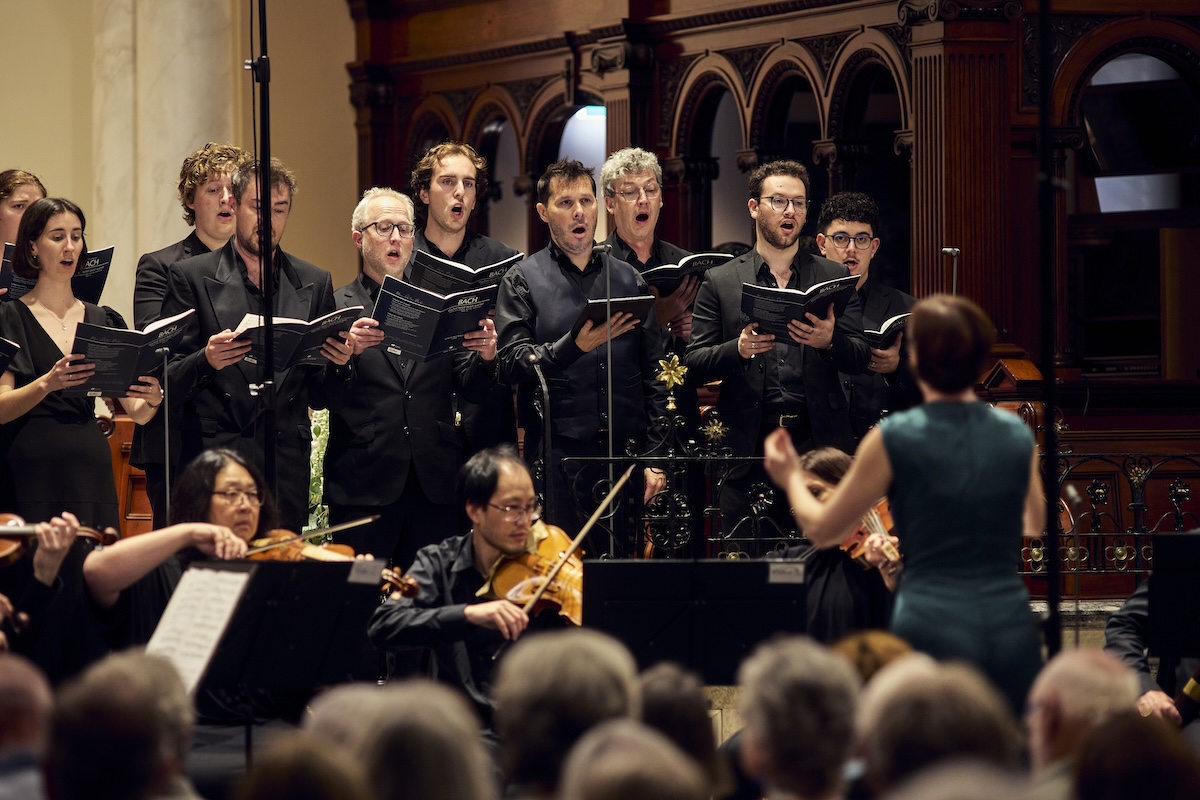
Bach + Charpentier (St James’s Church, Sydney). Photo © Keith Saunders
Charpentier’s Mass (H 9) is warmly enfolded within excerpts from his Noëls pour les instruments, instrumental versions of traditional French Christmas carols that he set in the 1690s and referenced in his Mass. His writing is innovative and diverse in structure but quintessentially French in its aesthetic, full of grace and light. His delicate scoring of the Noëls specifically included flutes to instil a pastoral flavour.
Easton has reconfigured the sequence of Noëls, highlighting the connection to the Mass while maintaining the integrity of its features. The flutes are replaced by recorders, a not uncommon exchange, distinctively piped by Alicia Crossley and BAA Emerging Artist Kit White. The first bracket of four Noëls opens with the salutary O créateur, followed by a lilting homage to the people of Châtres and two meditative tributes to the Virgin Mary, Or nous dites Marie and Une jeune Pucelle.
With these themes uppermost in the mind, the entire ensemble presents the Messe de minuit, composed for midnight Mass on Christmas Eve. The choir deftly navigates the polyphony, melismatic lines and rich chordal passages. Solo ensembles emerge from the choral textures, concertante passages from the orchestra.
Charpentier was an haute-contre himself and favours the three lower voices, sung by tenors Kyle Stegall and Timothy Reynolds and bass David Greco in well-blended trios, notably the Domine Deus. The two soprano soloists, Susannah Lawergren and St James’ Choral Scholar Veronica Vella, are a delightful pairing with the two flutes.
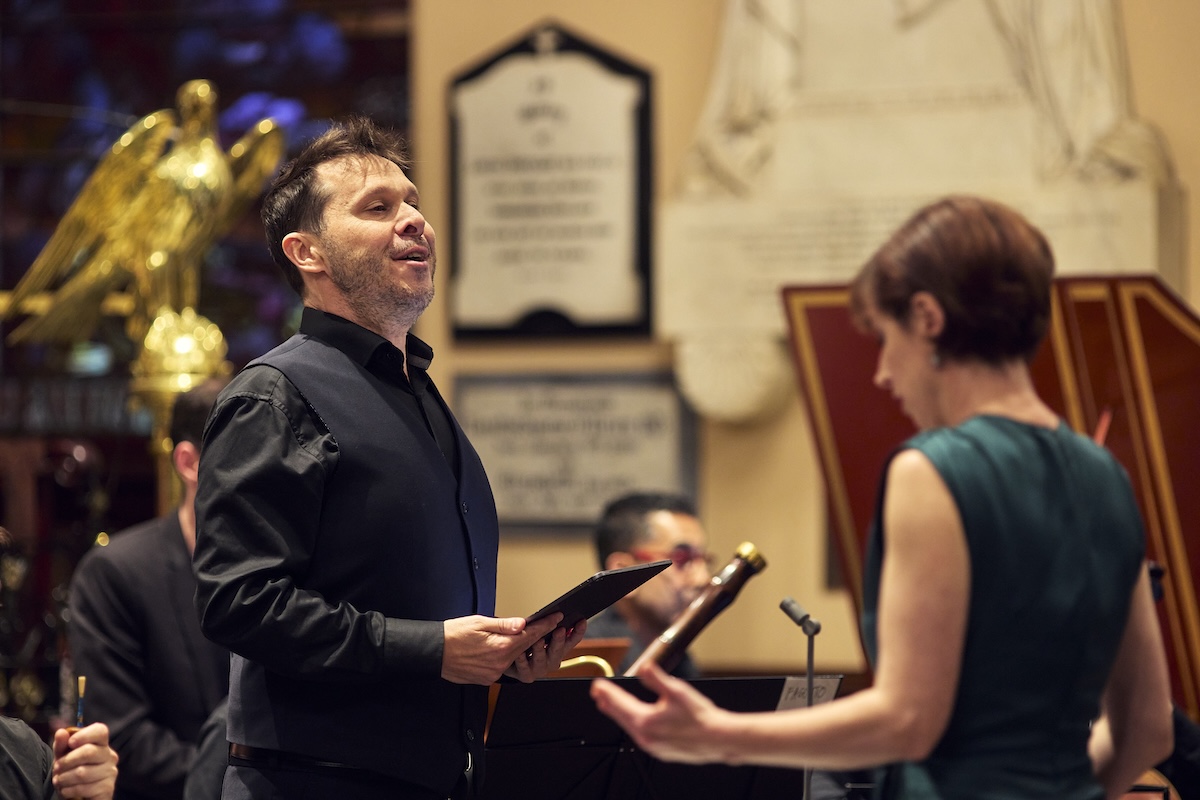
David Greco, Madeleine Easton, Bach & Charpentier (St James’s Church, Sydney). Photo © Keith Saunders
The Gloria is especially grand. Christmas Eve was the first occasion after Advent on which it would have been sung, having been omitted during Advent’s Tempus clausum, a time of quietude spent contemplating the coming of Christ.
Easton drives the tempo of the Mass with verve. This is, after all, a celebration, and there is little time for introspection.
The Mass concluded, the orchestra performs the second bracket of Noëls: the Arcadian pair Où s’en vont ces gais bergersand Laissez paîtres vos bêtes, followed by Vous qui désirez sans fin and a final statement of the theme in Joseph est bien Mari.
Brimming with rustic charm, these carols are very much of the people, elevated with Baroque artistry. The BAA fetchingly recreates the naivety of these carols.

Madeleine Easton and the Bach Akademie Australia Orchestra. Phtoto © Keith Saunders
The two cantatas by J S Bach have the same intent as Charpentier’s Mass, being sung by the populace during Advent. Yet they are a dramatic contrast, with strikingly different rhythms in the language, inflections of the German consonants and vowels, ornamentation, texture and counterpoint. The ensemble pivots neatly from the lucent French style to Bach’s more weighty and intricate writing.
Bach’s sacred music has the added layer of a more sober Protestant Lutheran ideology. The restraint is evident in the orchestration of BWV 62. Eschewing trumpets and timpani, Bach’s only nod to celebratory brass is the inclusion of a Corno, played by Michael Dixon, echoing the soprano line.
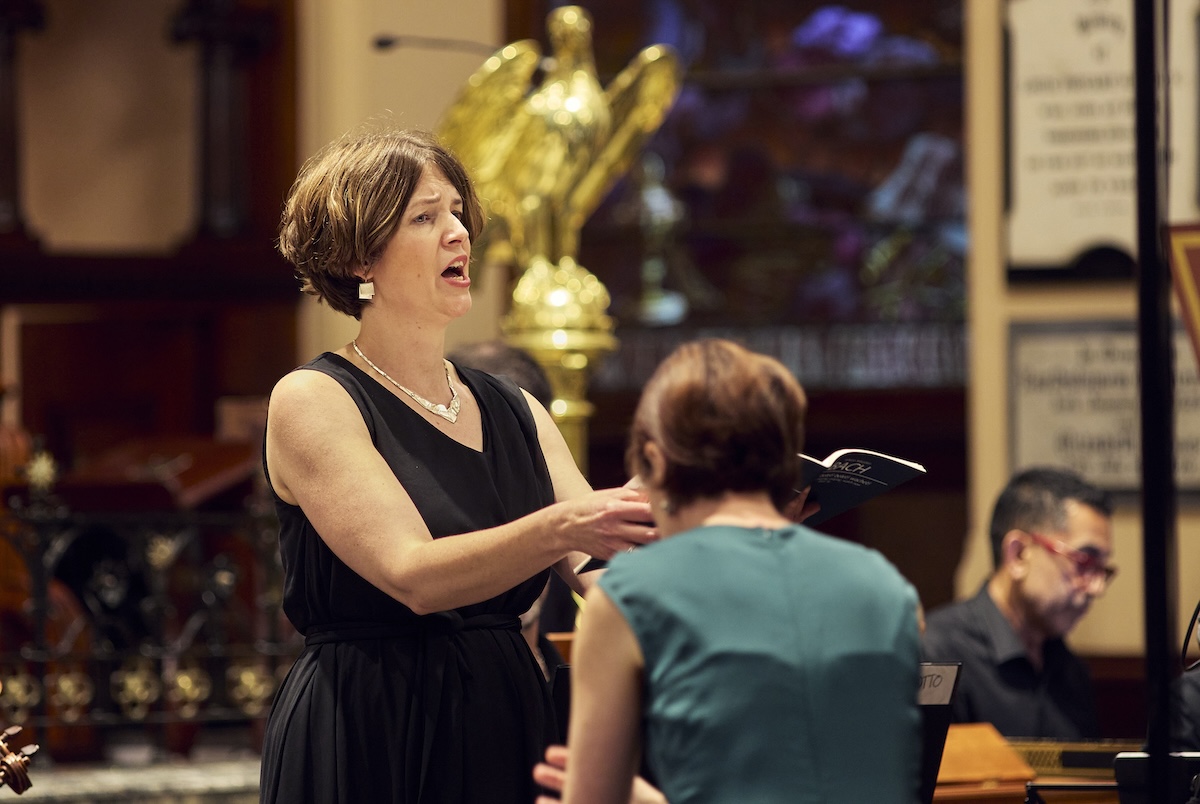
Susannah Lawergren, Bach & Charpentier (St James’s Church, Sydney). Photo © Keith Saunders
The cantata BWV 70 is unusual in being written in two parts, of seven and four movements, and includes the trumpet, played by Simon Wolnizer, which lends a more gleeful mood, alongside the piquant oboes of Adam Masters and Kailen Crisp.
Kyle Stegall is a lyrical and impassioned storyteller; Timothy Reynolds’ melismatic aria Bewundert, O Menschen is polished, with elegant phrasing; David Greco’s delivery is authoritative, emphasising the onomatopoeic text of the recitative–aria pair So geht aus Gottes Herrlichkeit…Streite, siege, starker Held!
Susannah Lawergren’s aria Lasst der Spötter Zungen schmähen is lithe and shimmering. BAA Emerging Artist mezzo-soprano Elizabeth Cooper is still slender in tone, but so expressive in her rendition of the alto aria Wenn kömmt der Tag.
There are delicious ironies in this program. One is the combining of the Catholic Charpentier’s music with that of the Lutheran Bach. Then there is the performance of Bach’s music in a Catholic church, when these two facets of Christianity have been so at odds over the centuries. And third, Bach’s cantatas were not intended as concert performances but as part of Sunday worship.
Fortuitously, none of these ironies matter when music has the power to override differences and audiences are able to enjoy expert live performances of this enduring and uplifting repertoire.
Bach Akademie Australia presented Bach & Charpentier: Music for Christmas at St Finbar’s Catholic Church, Glenbrook on 13 November, Our Lady of Dolours Catholic Church, Chatswood on 14 November and St James’ Church, King St Sydney on 15 November.





Comments
Log in to start the conversation.