




Few composers have had such a high profile in their national culture as Jean Sibelius (1865-1957) and the ASO’s presentation of all seven of his symphonies over three concerts is most welcome, allowing the fullest appreciation of his unique and wonderful compositional style.
Sandwiched between Sweden and Russia, Finnish territory was frequently and violently contested throughout its history. In 1809, it was absorbed into the Russian Empire as an autonomous grand duchy, and it did not gain independence until 1918. Sibelius grew up speaking Swedish (the Finnish language was suppressed), but in the latter part of the nineteenth century, a Finnish independence movement emerged.
While Sibelius denied programmatic readings of his work, claiming it to be “pure music”, he was seen as a national figurehead because his music seemed so characteristic of Finland’s landscape and folk culture, inspired as it was by the Kalevala, the book of epic Finnish poetry which was itself an assertion and celebration of Finnish identity.
Such was Sibelius’s early success that, in 1897, before any of his symphonies were completed, he was granted a state pension, albeit modest, for life, and in 1915 his 50th birthday was designated a national holiday.
This concert comprised two works, his Symphony No. 4 in A Minor Op. 63 of 1911 and his Symphony No. 2 in D Major, Op. 43 of 1902 – one of his least known works followed by one of his best known and most loved.

Mark Wigglesworth and the Adelaide Symphony Orchestra in Sibelius at Adelaide Town Hall. Photo © Jack Fenby/ASO
Sibelius’s brooding fourth symphony differed significantly from his warmly accessible and buoyant third. The first movement, Tempo molto moderato, quasi adagio, opens with a darkly severe theme in the bassoons with muted cellos and basses which introduces a slow, quiet and profoundly desolate cello passage.
The movement is characterised by dissonance and the frequent use of the tritone, rumbling timpani recur and occasional brighter moments in the brass appear like brief flashes of sunlight that are soon obscured in this dark winter. The cello’s haunted, introspective voice also recurs and might be seen to represent the composer himself.
The second movement, Allegro molto vivace, begins gently and sweetly in the winds and strings but the mood becomes gradually more disturbed and agitated, as if the gloom cannot lift. The movement ends quietly and is unresolved as if in mid-sentence.
The long third movement, Il tempo largo, opens quietly with a solemn flute passage and proceeds in an agonisingly slow but deeply emotional way, later gathering energy and reaching a tumultuous crescendo before again ending inconclusively.
The final Allegro begins brightly, and a brief glockenspiel passage could suggest the twinkle of sunlight, but the darkness inevitably returns and the symphony seems to fade out, as if the speaker has simply given up.
Most unusually for a symphony, and in stark contrast to the second, the fourth offers no happy or triumphant ending. Evidently, when asked about the fourth, Sibelius quoted playwright August Strindberg: “One feels pity for human beings”.

Mark Wigglesworth and the Adelaide Symphony Orchestra in Sibelius at Adelaide Town Hall. Photo © Jack Fenby/ASO
Various reasons have been suggested for the fourth’s darkness. Sibelius was reputedly unhappy with modernist developments in music and said that the symphony “stands as a protest against present-day music”. He had recently been treated for cancer and was faced with his own mortality. Life under Russian rule had become increasingly oppressive. And he had become interested in psychoanalysis though his psychiatrist brother – Sibelius evidently called it a “psychological symphony”.
Ultimately, the fourth symphony’s unanswered questions may be the composer’s intuitive response to a mid-life crisis precipitated by these and other troubles. His next, the glorious fifth symphony, suggests that this dark night of the soul had passed.
Sibelius’s magisterial Symphony No. 2 in D Major, Op. 43 (1901-1902), composed after a trip to Italy, is strongly Romantic in character, emotional and uplifting, and it was greeted as a rousing nationalistic statement by the Finnish public and critics.
It seems composed, as Sibelius put it, of fragments rather than melodies, so that the music is continually darting in new directions. But this sequence of disconnected thoughts coheres into a brilliant whole, sometimes sweetly melodious and tender, with soft woodwinds and strings, and sometimes intensely dramatic, with powerful brass and thunderous timpani.
Sibelius said that the second symphony represents the landscape around his home in Järvenpää, and it seems a quintessential depiction of Finland’s endless forests and lakes, populated by the spirits of the Kalevala.
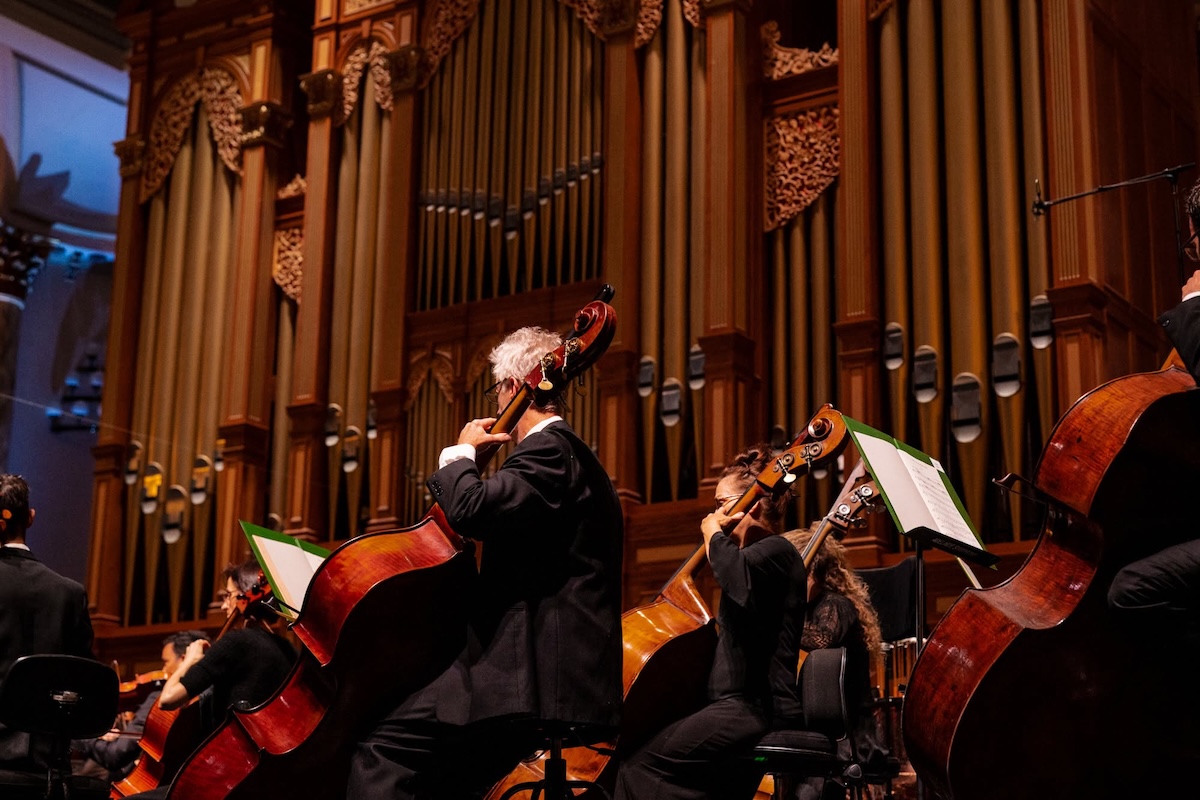
The Adelaide Symphony Orchestra in Sibelius at Adelaide Town Hall. Photo © Jack Fenby/ASO
The second symphony’s finale is triumphant, anthemic, and seems to confirm even more than to assert Finland’s individuality and its place in the world.
The ASO’s performance under conductor Mark Wigglesworth was magnificent. Sibelius’s music features extensive use of timpani and hard-working timpanist Andrew Penrose was outstanding, as were the winds and brass sections and principal cellist Sharon Grigoryan.
Mark Wigglesworth and the Adelaide Symphony Orchestra play Sibelius at Adelaide Town Hall on 19 September.








Comments
Log in to start the conversation.