




This remarkable concert is the first that results from a collaborative project between the ASO, Adelaide University’s Centre for Aboriginal Studies in Music (CASM) and Adelaide’s longstanding contemporary music ensemble, Soundstream New Music.
The concert brings together important First Nations musical threads, and it results in part from an Australian Research Council-funded project entitled Fine Tuning: A Reconciliation of Indigenous and Western Musical Traditions, led by Wiradjuri-European composer and CASM co-director Dylan Crismani.
Crismani’s project evidently has several aims: to redress the cultural power imbalance between Indigenous and Western music and give Indigenous music a more prominent voice in Australian music; to extend the knowledge of the intricate tuning systems of traditional Indigenous musical practice; and to reconnect three Central Australian communities with their traditional song lines.
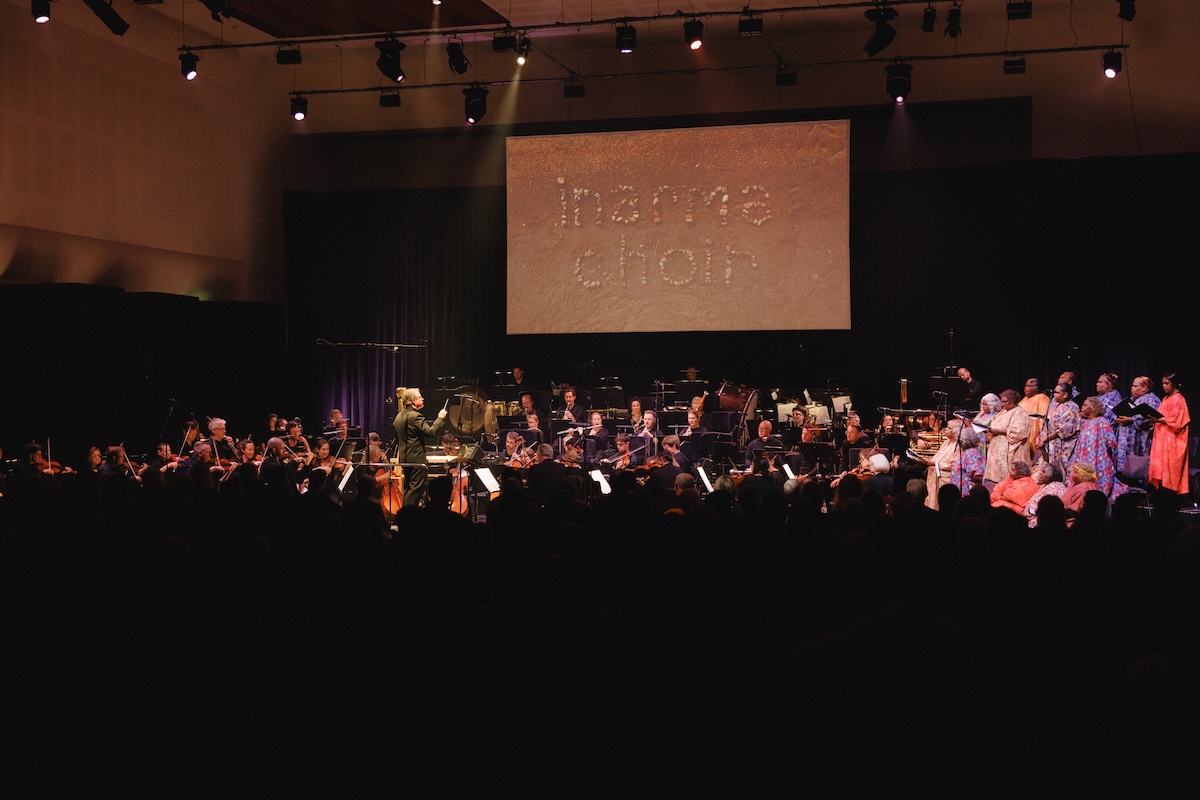
Adelaide Symphony Orchestra, Inarma Choir & Nathan May: Waltjapiti Tjungu. Photo © Bri Hammond
Founded in 1972, CASM is said to be the only university-based centre for studies in First Nations music, and it has promoted First Nations music and musicians, including forming the bands No Fixed Address, Us Mob, Coloured Stone and Knuckles.
Soundstream, founded in 1993 and led by pianist and composer Gabriella Smart, is a central element of Adelaide’s contemporary music scene, promoting a wide range of music, musicians and new composition locally and overseas.
Smart has a particular interest in supporting First Nations musicians, particularly in the Titjikala community southeast of Alice Springs. She has worked with the Titjikala community since 2015 to establish and support the Pitjantjatjara Yankunytjatjara women of the 15-member Inarma Choir, comprising women from the Pukatja, Mimili, Alice Springs and Amoonguna communities as well as the Titjikala community. The intention of Soundstream’s Titjikala Project is to promote musical education and the retention of cultural traditions, and to provide broader health and economic benefits for those communities.
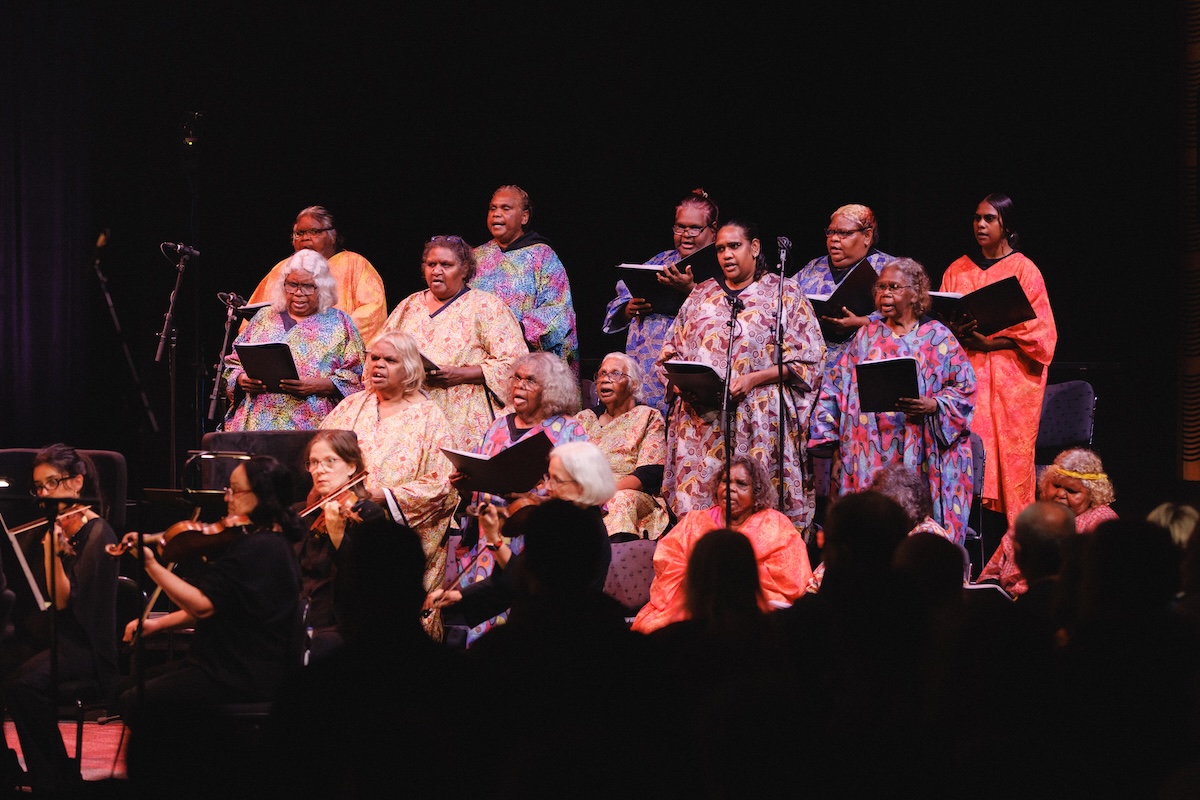
Adelaide Symphony Orchestra, Inarma Choir & Nathan May: Waltjapiti Tjungu. Photo © Bri Hammond
In introducing this concert, Crismani said that the ASO had adapted its tuning to traditional tuning – some string players retuned their instruments between performances, and, as well as enabling the performance of the traditional elements of the compositions, the tunings heard in this concert symbolise reconciliation. Electronic elements were also incorporated, greatly expanding the ASO’s typical sound palette.
The concert featured three works, beginning with Elisha Umuhuri’s The Story The Wind Refused To Forget. CASM graduate Umuhuri is an Aṉangu Pitjantjatjara Yankunytjatjara composer, producer, and founding member of the Aboriginal hip-hop group Dem Mob, the first such group to perform and record in both the Pitjantjatjara language and English.
Umuhuri spoke of his need to find new ways to retain his cultural heritage while adapting to the present world and noted that Indigenous people need to work ten times harder to gain recognition.
Beautifully orchestrated by prominent young Adelaide composer Connor Fogarty, Umuhuri’s The Story The Wind Refused To Forget opens with a low rumble in the basses, some ethereal string playing with keyboard elements emerges, and a horn motif recurs. This haunting work is grounded in a speech-like hip-hop rhythm featuring the sound of clapsticks.
The second work was by another CASM graduate, Nathan May, an Adelaide-based singer-songwriter of Arabana, Yawuru, and Marridjabin ancestry known for his contemporary country and folk storytelling.
May’s Finnis Inga is effectively a song cycle in which he sings while accompanying himself on acoustic guitar. The songs tell a personal story and honour his grandmother, and Fogarty has drawn on May’s country and western-flavoured melodic lines and rhythms to create an ethereal orchestration evoking the open space of the desert.

Adelaide Symphony Orchestra, Inarma Choir & Nathan May: Waltjapiti Tjungu. Photo © Bri Hammond
The 15-member Inarma Choir, with Makinti Minutjukur and Katrina Tjitay, gave the final performance of the evening, a selection of songs entitled Waltjapiti Tjungu (Together, One Family). The songs are composed by Yankunytjatjara women Makinti Minutjukur and Katrina Tjitayi, the Titjikala Desert Oaks Band and Rupert Jack (Mimili).
Smart indicated that their program included three Lutheran hymns sung in Language together with traditional songs performed with orchestral accompaniment. For one song, four dancers performed a traditional dance, and the choir’s performance was accompanied by video footage of Country and of the drawing of traditional symbols in sand with a stick. The sound of bird song punctuated the delicately nuanced orchestration.
To conclude this unique and well executed concert, the choir performed another song unaccompanied.
The three elements of this innovative concert formed a highly original and very musical body of work that, as intended, draws on Indigenous and western musical traditions, taking the best of both worlds to create a fusion that can be celebrated by Indigenous and western communities alike. The inclusion of Lutheran hymns and traditional song in the Inarma Choir’s program suggests a parallel in the spiritual traditions of Indigenous and western culture.
The ASO’s performance, under conductor Luke Dollman of Adelaide University’s Elder Conservatorium, was excellent throughout. A printed program detailing the music’s titles and lyrics and the backgrounds and interests of all the performers and composers would have greatly aided audience appreciation and stood as a record of this landmark event, but unfortunately none was provided.








Comments
Log in to start the conversation.