South Korean virtuoso Yeol Eum Son’s pianism is often praised for its combination of crisp articulation, grace, poetry and power – the full set, in fact – but she can also swing, as she showed both in her recording of Nikolai Kapustin’s works, and in this performance of Tchaikovsky’s blockbuster Piano Concerto No. 1.
She crouches over the keyboard more like a jazz player than a classical concert pianist, throwing back her head and kicking out a leg in the more propulsive episodes, her long black hair often obscuring her face, which is always animated with a range of expressions.
All of this makes for a great show and the listener gets swept along by the sheer energy she puts out. But there is the colour, control of structure and adventurous but judicious use of the pedal that all combine to make this an edge-of-seat experience. It also puts bums on seats and the spontaneous standing ovation she received after the final joyful cadence was bigger and louder than I have heard in a long time.
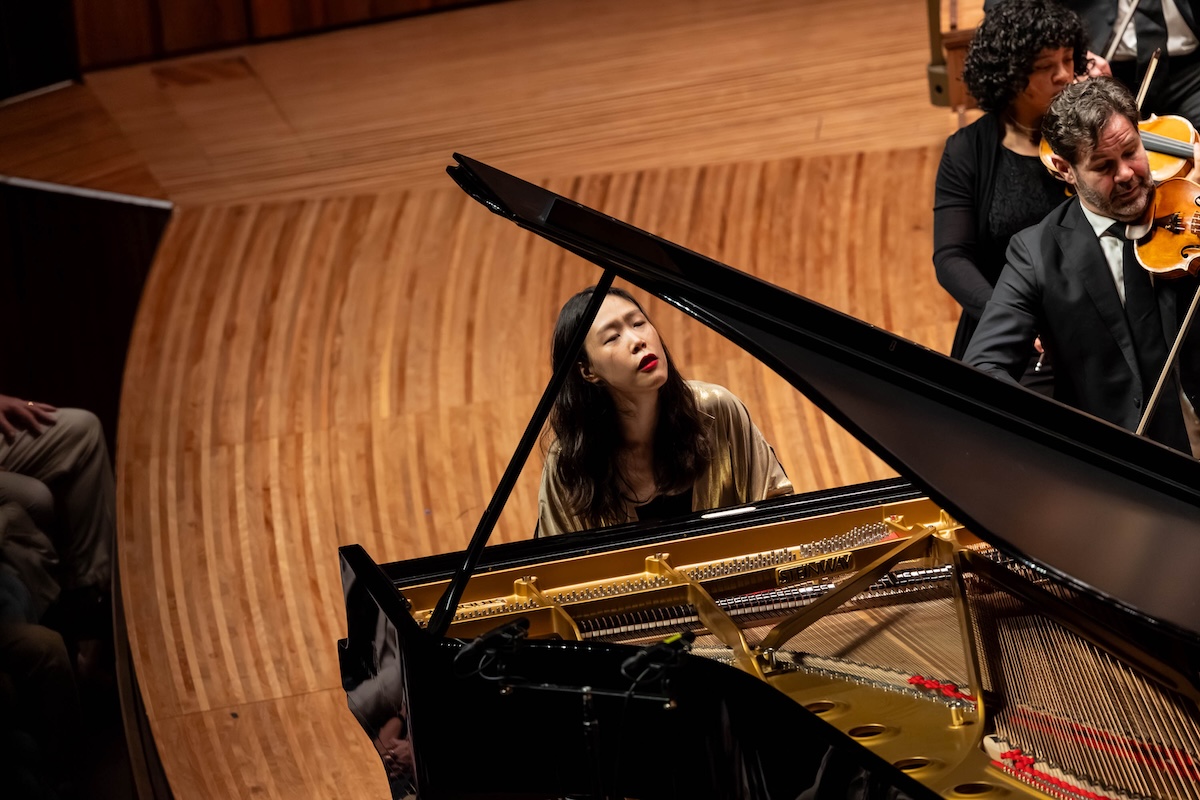
Yeol Eum Son, Sydney Opera House Concert Hall. Photo © Ken Leanfore
The three concerts mark the return of the 40-year-old silver medallist in the 2011 International Tchaikovsky Competition where video of her playing Mozart’s Piano Concerto No. 21 garnered a record-breaking 31 million online views.
She was here in 2022 performing Mozart’s No. 20 under former Sydney Symphony Orchestra Chief Conductor Edo de Waart.
The tour also celebrates the return of dynamic young Canadian conductor Nicolas Ellis, a protégé of Yannick Nézét-Séguin, who in 2024 stepped in to replace eminent British conductor Sir Andrew Davis who had died a few months before.
After Tchaikovsky’s celebrated massive opening movement and Yeol Eum’s magical handling of its candenza makes everybody sit forward in their seats, you could have heard a pin drop during the Andantino middle movement with glorious solos from flautist Lily Bryant, cellist Simon Cobcroft and oboist Shefali Pryor.

Sydney Symphony Orchestra (Nicolas Ellis conductor), Sydney Opera House Concert Hall. Photo © Ken Leanfore
The orchestra was in fine form, and they needed to be for the brace of debut symphonies also on the program. The SSO’s Principal Violist Justin Williams has established himself as a talented composer of attractive chamber and solo piano music, but his 2023 Symphony No. 1, jointly commissioned by the Queensland Symphony Orchestra and the SSO, marks his first major orchestral venture.
For this he is uniquely qualified, sitting in the middle of it all for his night job in the viola section, and he makes the most of his knowledge of the characters and abilities of his colleagues. Solo moments are generously handed out in the four-movement 25-minute work played straight through.
Alexandre Oguey’s cor anglais is key to the symphony, almost acting as a narrator at times as Williams examines how time flies – punctuated by moments of pause and reflection – in the epic, cinematic sweep of the compact opening. Next comes a march with some showcase moments for winds and brass before the slow third movement featuring lovely Sheherazada-like melodic solo lines from bassoon, oboe and cor anglais.
If this movement is all about colours and textures the final movement is fast and aimed, in Williams’s words, at “making it fun for the musicians”. The tubular bells get a workout and the percussion department is kept busy and it all ends with the opening theme closing on a positive note.
Piccolo players must all feel very thankful to Dmitri Shostakovich and his 15 symphonies, many of which feature those shrill high notes that cut across his massive tutti climaxes. This was certainly a feature of the recent Australian World Orchestra’s performance of the Tenth Symphony and the baby flute has plenty to say in his First, as well.
This was written as a graduation work when he was a student at Leningrad (now St Petersburg) Conservatory. It’s hard to imagine what his fellow students must have felt when they heard it. His use of the piano, a 20-strong wind and brass section and command of his material over a 30-minute work still impress us today.
Ellis, whose energy and clarity on the rostrum and winning stage presence make him an engaging leader, brought out the very best from his troops.

Comments
Log in to start the conversation.